
What Is a Manufacturing Marketing Agency?
A manufacturing marketing agency is a specialized industrial marketing firm that helps B2B manufacturers and industrial companies generate qualified leads, build brand authority, and drive measurable revenue. Unlike generic digital marketing agencies built for SaaS or consumer brands, a manufacturing marketing agency understands the unique marketing challenges of long sales cycles, technical buying committees, and engineering-focused content.
The right marketing partner for a manufacturing business handles the full marketing program — from industrial SEO and content marketing to LinkedIn campaigns, marketing automation, account-based marketing, and trade show enablement — so the in-house team can focus on sales, operations, and product development.
What services do manufacturing marketing agencies offer?
Full-service manufacturing marketing agencies typically deliver an integrated set of marketing services tailored to the industrial sector:
- Industrial SEO and technical content marketing that ranks for the specifications, processes, and certifications buyers actually search for
- LinkedIn and B2B paid marketing campaigns targeted at engineering, procurement, and operations decision-makers at named target accounts
- Marketing automation and lead nurturing that runs across 6–18 month manufacturing sales cycles
- Account-based marketing programs for high-value enterprise accounts
- Trade show and event marketing that ties booth presence to measurable RFQs and pipeline
- Manufacturing website design and conversion optimization for capabilities pages, RFQ flows, and engineering content libraries
The best manufacturing marketing agencies combine deep industrial marketing expertise with modern digital marketing tactics. That combination is what separates a marketing partner that delivers RFQs from a generic marketing agency that just generates traffic. If you're evaluating agencies right now, our manufacturing marketing agency page covers our services, results, and how an engagement works.
Why hire a specialized industrial marketing agency?
Generic agencies that work primarily with SaaS or e-commerce brands struggle with manufacturing. They don't understand 14-month sales cycles, can't translate engineering specifications into content, and miss the technical depth that builds trust with industrial buyers. The result is a marketing campaign that produces clicks but no qualified RFQs.
A specialized industrial marketing agency brings manufacturing case studies, in-house technical writers, and proven SEO results for B2B industrial keywords. An agency that understands manufacturing speaks the same language as your engineering team — translating capabilities, certifications, and tolerances into content that helps manufacturers actually win deals. That specialization is the single biggest differentiator when evaluating marketing agencies for an industrial manufacturing business.
What Is Manufacturing Marketing?
Manufacturing marketing is the strategic process of promoting and selling products or services from one manufacturing business to another — or directly to buyers in the manufacturing sector. Unlike consumer-facing brands, this discipline requires a deep understanding of complex B2B sales processes, technical procurement decisions, and long sales cycles that can span months or even years.
In the world of B2B manufacturing, your target audience isn't scrolling social media for impulse buys. They're engineers evaluating specifications, procurement managers comparing total cost of ownership, and C-suite decision-makers weighing capital expenditures. Effective manufacturing marketing speaks directly to these stakeholders with tailored marketing strategies built around their specific pain points and buying processes.
Today's manufacturing industry is undergoing a digital transformation. Many manufacturing companies that once relied exclusively on trade shows, word-of-mouth referrals, and cold calling are discovering that a strong marketing strategy for manufacturing is essential for survival. The manufacturing landscape has shifted — B2B buyers now complete 70% of their research online before ever contacting a sales team.
What Makes Manufacturing Marketing Different from B2C
Unlike B2C marketing, where emotional impulse drives most purchasing decisions, B2B manufacturing marketing operates in a fundamentally different environment. Understanding what makes manufacturing marketing unique is the first step toward building marketing strategies that actually convert.
6–18
Months: Average B2B Manufacturing Sales Cycle
6–10
Decision-Makers Involved in Manufacturing Purchases
Here are the unique challenges that set this discipline apart from traditional marketing:
- Complex B2B buying committees: Manufacturing purchases typically involve 6–10 stakeholders — from engineers and plant managers to procurement officers and CFOs. Your message must address each persona's concerns across multiple touchpoints.
- Long sales cycles: Unlike a consumer product that sells in seconds, manufacturing sales cycles stretch from months to years. Marketing activities must nurture leads through every stage, not just generate initial awareness.
- Technical depth required: Manufacturing buyers expect white papers, specification sheets, and case studies — not surface-level blog content. Your content marketing strategy must demonstrate genuine expertise.
- Relationship-driven decisions: In the industrial sector, trust and reliability outweigh price. Your approach must build trust through demonstrated competence, not just promotional messaging.
- Niche target audiences: Your ideal customer profile may be extraordinarily specific — perhaps procurement managers at aerospace companies with $50M+ revenue. Mass approaches simply don't work here.
These unique challenges mean that the right strategies for manufacturing companies look nothing like what works for retail or e-commerce. Manufacturing marketing requires a specialized, tailored marketing approach that accounts for every stage of the complex B2B buyer's journey.
7 Manufacturing Marketing Strategies That Drive Growth
The most effective manufacturing marketing strategies combine digital marketing tactics with proven industrial marketing approaches. Below are the top manufacturing marketing tactics that B2B manufacturers use to generate qualified leads, shorten the sales cycle, and drive growth across their entire pipeline.
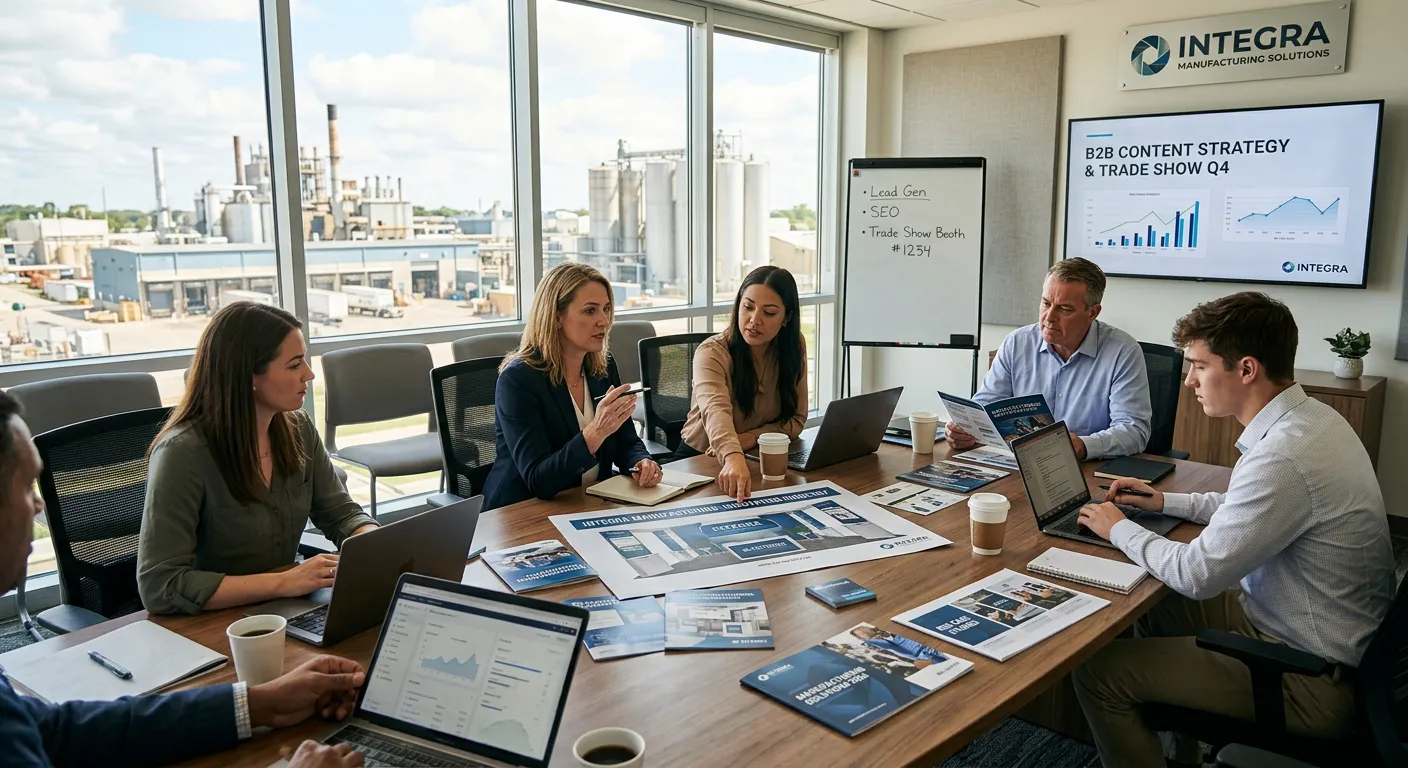
1. Leverage Content Marketing & Case Studies
Content marketing is the foundation of every strong manufacturing marketing strategy. In a complex B2B environment where buyers need to justify every purchase to multiple stakeholders, leveraging content marketing gives your sales team the ammunition they need to move deals forward.
A well-executed content marketing strategy includes:
- Technical case studies that show real results with specific manufacturing products — these are the single most valuable asset for B2B marketing
- White papers addressing engineering challenges your ideal customer faces
- Blog posts covering industry trends, regulatory changes, and supply chain insights
- Product specification guides that procurement teams can share internally
- Video content showcasing your processes and capabilities
Creating marketing materials that serve double duty — generating organic traffic through SEO while equipping your sales and marketing teams with resources — is the hallmark of effective manufacturing marketing. The best manufacturing marketers treat content as a long-term marketing engine, not a one-time campaign.
2. SEO & Search Engine Optimization for B2B Manufacturing
Search engine optimization is non-negotiable for any manufacturing marketing plan. When buyers search for suppliers, components, or services, your website needs to appear at the top of results. SEO is how you capture demand from those who are already in-market.
Effective SEO requires:
- Technical foundation: Fast page speeds, mobile-responsive design, structured data markup, and clean site architecture
- Keyword targeting: Optimize your website for the specific search terms buyers use — think "precision CNC machining services" rather than generic terms
- Local presence: Manufacturing is inherently geographic. Target "[service] + [city]" searches to capture high-intent regional queries
- Content depth: Search engines reward comprehensive, authoritative content — which is exactly what your technically-minded audience wants
SEO delivers the highest ROI of any digital channel because it captures existing demand rather than creating it. When someone searches for your exact capabilities, they're already in the sales cycle. That's a lead your sales team can actually close.
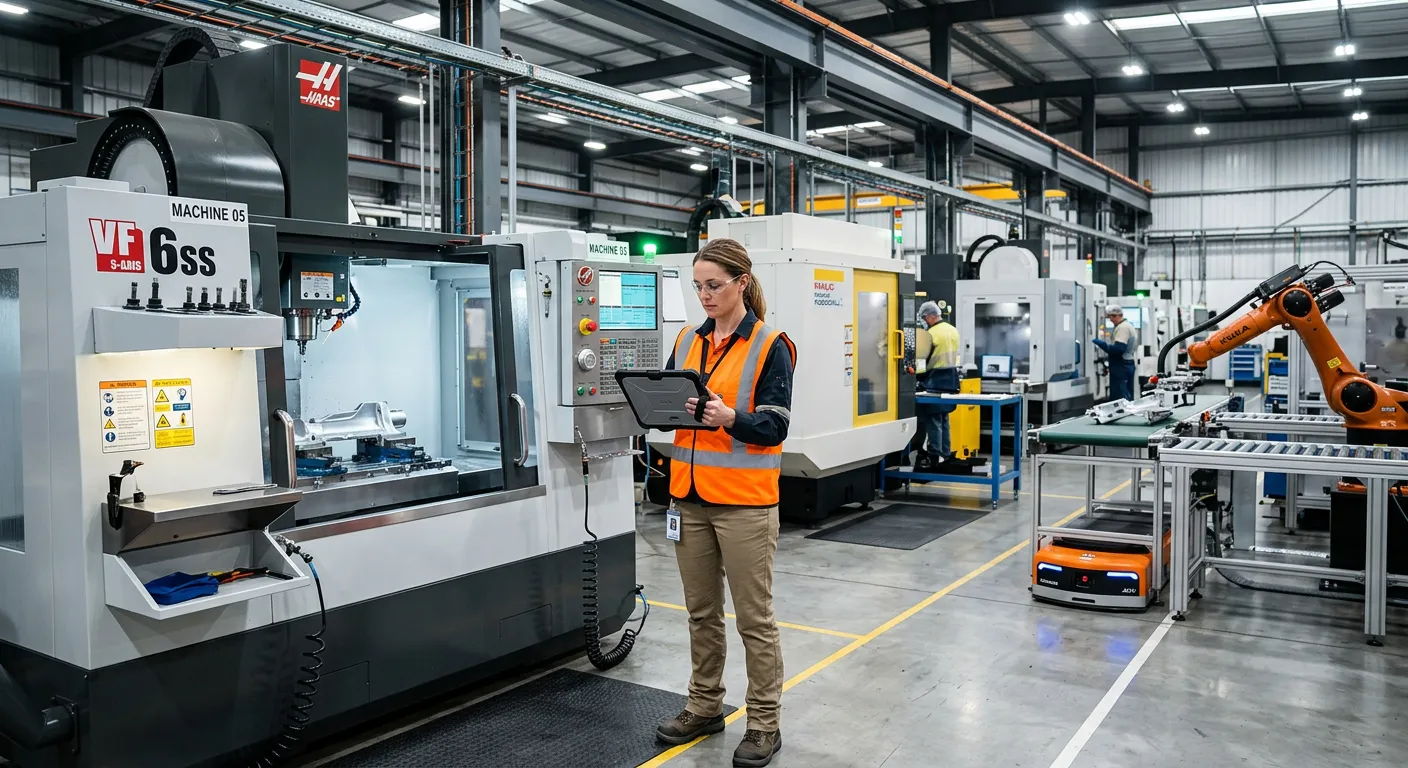
3. LinkedIn & Social Media for B2B Manufacturers
LinkedIn is the single most effective social platform for reaching manufacturing buyers. While other channels can supplement your overall marketing efforts, LinkedIn is where procurement managers and engineering decision-makers actually spend their professional time.
A strong social media strategy includes:
- Company page optimization with capabilities, certifications, and customer success stories
- Thought leadership content from your engineering and leadership team to establish brand authority
- Targeted advertising aimed at specific job titles, company sizes, and industries within the manufacturing sector
- Employee advocacy programs where your marketing team empowers engineers and sales reps to share technical content
LinkedIn also feeds directly into account-based marketing initiatives. You can identify target accounts, engage key stakeholders with tailored messaging, and leverage analytics to measure engagement across your ideal customer profiles.
4. Trade Show Strategy for the Manufacturing Industry
Trade shows remain a cornerstone of industrial marketing — and for good reason. In an industry where buyers want to see, touch, and evaluate products firsthand, event presence builds credibility that no digital channel can fully replicate.
However, effective manufacturing marketing transforms these events from expensive networking into measurable lead generation machines:
- Pre-show outreach: Use email marketing and LinkedIn to schedule meetings with target accounts before the event
- Compelling booth experience: Showcase capabilities with live demonstrations, not just brochures
- Lead capture and scoring: Use marketing automation to immediately categorize and follow up with every contact
- Post-show nurturing: Deploy a targeted email sequence within 24 hours of the event

5. Email Marketing & Marketing Automation
Given the long sales cycles in B2B manufacturing, email marketing combined with marketing automation is essential for staying top-of-mind with prospects who aren't ready to buy today but will be in six months.
Automation goes beyond basic newsletters. Effective marketing activities include:
- Lead nurturing sequences that deliver relevant content based on where each prospect is in the sales cycle
- Behavioral triggers — when a procurement manager downloads a specification sheet, your system automatically sends related content
- Sales-qualified lead scoring that alerts your sales team when a prospect's engagement signals buying intent
- Webinars and virtual events that educate your target audience while capturing high-intent leads
The goal isn't to flood inboxes — it's to deliver the right message at the right time. Marketing automation makes this scalable, ensuring no lead falls through the cracks during a 12-month B2B sales process.
6. Account-Based Marketing (ABM) for Manufacturing Companies
Account-based marketing is a natural fit for companies where a single contract can be worth millions. Instead of casting a wide net, ABM focuses your marketing budget on a defined list of high-value target accounts with a unified strategy across all channels.
An effective ABM approach includes:
- Account identification: Define your ideal customer profile based on industry, revenue, location, and specific needs
- Personalized outreach: Create tailored marketing strategies for each target account — custom landing pages, personalized email sequences, and direct mail
- Multi-channel engagement: Coordinate LinkedIn, email, webinars, and even trade show meetings with the same accounts
- Sales and marketing alignment: ABM only works when sales and marketing teams operate from the same playbook, sharing intel on buyer personas and engagement signals
7. PPC & Paid Advertising Strategy
While SEO builds long-term organic visibility, a PPC strategy provides immediate lead generation for companies entering new markets or launching new products. Paid advertising in this space demands precision — every wasted click is a wasted dollar of your marketing budget.
- Google Ads: Target high-intent keywords like "custom metal fabrication quotes" or "industrial automation supplier" — the cost-per-click is high, but so is the contract value
- LinkedIn Ads: Reach specific buyer personas at target companies with sponsored content, InMail, and dynamic ads
- Retargeting: Re-engage visitors who viewed your capabilities pages but didn't convert — keeping your brand top-of-mind throughout long sales cycles
The key to any PPC strategy is ruthless optimization. Track cost-per-lead, cost-per-opportunity, and ultimately cost-per-closed-deal to ensure your paid channels deliver measurable ROI, not just clicks.
How to Build a Manufacturing Marketing Plan
Every effective program starts with a documented marketing plan. Without one, marketing efforts become scattered and impossible to measure. Here's how manufacturers create effective plans that translate directly into B2B sales growth:
Define Your Ideal Customer Profile & Buyer Personas
Start by documenting exactly who your manufacturing business serves. Build buyer personas for every stakeholder in the buying committee — the engineer who evaluates, the procurement manager who compares, and the executive who approves. Include company size, industry vertical, geographic region, and the specific problems you solve.
Audit Your Current Marketing Activities
Before building new strategies, evaluate your current marketing landscape. What channels are driving leads? Where are the gaps? Many companies discover their website is invisible to search engines, their trade show follow-up is nonexistent, or their LinkedIn presence is dormant. An honest audit prevents wasting your marketing budget on tactics that aren't working.
Select & Prioritize Your Channels
Based on your audit and personas, select the manufacturing marketing tactics most likely to reach your target audience. Most B2B manufacturers should start with SEO and content marketing as the foundation, then layer in LinkedIn, email, and events. Don't try to do everything — prioritize two to three channels and execute them well before expanding.
Set Measurable Goals & KPIs
Manufacturing marketing success must be measurable. Set specific targets for website traffic, lead volume, lead quality, pipeline value, and revenue attributed to your efforts. Use analytics to track performance indicators across every channel. If you can't measure it, you can't optimize it.
Build a Repeatable Marketing Engine
The goal is to build a manufacturing marketing engine — a repeatable system that generates leads consistently, not sporadically. This means establishing a content calendar, automation workflows, regular LinkedIn publishing, and a systematic trade show strategy. Proven strategies work because they're executed consistently over time, not because of one-off campaigns.
How do you market a small manufacturing business? The same framework applies — just at a different scale. Small manufacturers should leverage SEO and inbound marketing as their primary channels because these strategies built on content deliver disproportionate returns relative to marketing budget. A single well-optimized page can generate leads for years.
How to Align Sales and Marketing Teams in Manufacturing
The biggest driver of manufacturing marketing success — and the most common source of failure — is the relationship between sales and marketing teams. In many organizations, these groups operate in separate silos with different goals, different metrics, and different definitions of a "qualified lead."
To align sales and marketing in your manufacturing business:
- Define lead qualification together: Both teams must agree on what constitutes a marketing-qualified lead (MQL) vs. a sales-qualified lead (SQL). Without shared definitions, one side sends junk and the other ignores everything.
- Implement closed-loop reporting: Your marketing team needs to know which leads ultimately closed — and at what revenue — so they can optimize efforts toward the highest-value channels.
- Create shared content: Your sales team knows the objections. Your content creators know how to address them at scale. Together, they create assets that accelerate every stage of the sales cycle.
- Regular pipeline reviews: Monthly meetings where both groups review pipeline health, lead quality, and campaign performance prevent the finger-pointing that kills growth.
Manufacturing marketing must evolve from a support function to a strategic revenue driver. When marketing and sales operate as a unified strategy, the entire manufacturing sales cycle accelerates — from first touchpoint to signed contract.
Measuring Manufacturing Marketing ROI
Are you confident your current marketing efforts are generating maximum ROI? For many B2B manufacturers, the honest answer is no. Manufacturing marketing requires rigorous measurement because the stakes are high — campaigns can cost tens of thousands, and manufacturing purchases represent significant capital commitments.
Here are the key metrics every marketing team should track:
| Metric | What It Measures | Why It Matters |
|---|---|---|
| Cost Per Lead | Spend / leads generated | Ensures your marketing budget is efficient |
| Lead-to-Opportunity Rate | % of leads becoming sales opportunities | Validates lead quality, not just volume |
| Pipeline Velocity | Speed leads move through the funnel | Shows if your approach accelerates deals |
| Revenue Attribution | Revenue from generated leads | The ultimate ROI measure |
| Customer Acquisition Cost | Total cost to win one new customer | Benchmarks overall efficiency |
Optimize your reporting by connecting analytics directly to your CRM. This lets you trace every closed deal back to the original touchpoint — whether that was an SEO-driven website visit, a trade show conversation, or a LinkedIn InMail. Without this closed-loop measurement, you're making decisions based on guesswork, not data.
The most successful manufacturing marketers review these metrics monthly and optimize their overall marketing strategy quarterly. Manufacturing marketing success isn't about perfection on day one — it's about continuous improvement driven by measurable results.
Common Manufacturing Marketing Challenges (And How to Solve Them)
Even with the right strategies, companies in this space face persistent marketing challenges that can stall growth. Here are the most common obstacles — and proven solutions:
"We've always relied on referrals and word-of-mouth."
Referrals are valuable but unpredictable. A marketing strategy for manufacturing supplements referrals with systematic lead generation — so your pipeline doesn't dry up when referral momentum slows. Traditional marketing channels shouldn't be abandoned; they should be augmented with digital.
"Our products are too technical for content."
Technical complexity is your competitive advantage, not a barrier. Manufacturing buyers crave depth. A well-written white paper or detailed case study that demonstrates engineering excellence will outperform generic content every time. Leverage your engineering team's knowledge as fuel for strong manufacturing marketing.
"We don't have a dedicated team."
Many manufacturing companies run lean. Consider partnering with a marketing agency that specializes in B2B manufacturing — they bring expertise without full-time overhead. Even a part-time coordinator who manages your SEO, LinkedIn, and email can transform your lead generation.
"We tried digital marketing and it didn't work."
Marketing in manufacturing requires patience and precision. If a previous campaign failed, it likely lacked proper targeting, sufficient duration, or sales cycle alignment. Effective manufacturing marketing isn't a sprint — it's a system that compounds over time. The right strategies, executed consistently, produce inbound marketing results that grow month over month.
Overcoming these marketing challenges requires a shift in mindset. Effective manufacturing marketing is not an expense — it's an investment that generates measurable returns. B2B marketing in the manufacturing space demands persistence, but those who commit to a strong, data-driven marketing approach consistently outperform competitors who rely on outbound-only tactics.
Frequently Asked Questions
The most common questions we hear from B2B manufacturers evaluating their marketing options — covering agency vs in-house decisions, budgets, timelines, and what actually drives ROI in the manufacturing sector.
What does a manufacturing marketing agency do?
A manufacturing marketing agency builds and executes lead-generation programs tailored to B2B manufacturers. That typically includes SEO and content marketing aimed at engineers and procurement buyers, LinkedIn campaigns targeting buying-committee personas, trade show enablement, marketing automation for long sales cycles, and account-based marketing for high-value target accounts. The right agency understands long sales cycles, technical buying committees, and how to translate engineering capabilities into compelling marketing assets.
Should manufacturers hire a marketing agency or build an in-house team?
It depends on budget, timeline, and complexity of your offering. An agency typically delivers expertise faster and at lower fixed cost — useful for manufacturers who need SEO, content, and ABM stood up in months rather than years. In-house teams build deeper product knowledge and tighter sales alignment over time but require leadership hires and a 12–24 month ramp before they outperform a specialist agency. Many manufacturers run a hybrid model: an in-house marketing coordinator paired with an agency that handles SEO, content production, and demand generation.
How much does manufacturing marketing cost?
Most B2B manufacturers invest $5,000–$25,000 per month in active marketing programs, depending on scope. SEO and content programs typically run $3,000–$10,000 per month, LinkedIn paid campaigns add $2,000–$8,000 per month in media plus management, and full-funnel ABM programs targeting enterprise accounts can exceed $20,000 per month. As a benchmark, manufacturing companies serious about growth allocate 5–10% of revenue to marketing — well below B2C norms but high enough to fund SEO, content, paid LinkedIn, and trade show presence simultaneously.
How long does it take to see ROI from manufacturing marketing?
Expect a 6–12 month ramp before marketing materially impacts pipeline. SEO and content marketing compound — the first measurable lead-flow uplift typically appears at month 4–6, with results accelerating through month 12. LinkedIn paid and ABM can produce qualified meetings within 30–60 days of launch but require continuous spend. Manufacturing's long sales cycle (6–18 months) means marketing-sourced revenue lands 12–24 months after program launch, even when leads come in earlier. Plan budget around the full ramp, not the first quarter.
What's more important for manufacturers — content marketing, SEO, or ABM?
All three feed each other, but the right starting point depends on your sales motion. If you sell standardized products or services to a broad market — CNC machining, custom fabrication, contract manufacturing — start with SEO and content because buyer-intent searches drive RFQs. If you sell complex, high-ticket solutions to a finite list of named accounts, start with ABM and LinkedIn because targeted outreach beats broad reach. Most manufacturers need all three eventually, but sequencing matters — choose the channel where your buyers already are.
What should I look for when evaluating a manufacturing marketing agency?
Five things separate specialist agencies from generalists. First, manufacturing case studies with revenue or RFQ outcomes, not just traffic numbers. Second, in-house technical writers or editors who can translate engineering content without dumbing it down. Third, demonstrated SEO results for B2B industrial keywords, not just consumer-facing brands. Fourth, experience aligning marketing with sales teams that run 6–18 month sales cycles. Fifth, transparent reporting that ties activities to pipeline and revenue, not vanity metrics. Ask for references from manufacturers in your sub-vertical.
How is manufacturing marketing different from regular B2B marketing?
Three things make manufacturing marketing structurally different. The buying committee is larger — typically 6–10 stakeholders spanning engineering, procurement, operations, and finance — so messaging must address each persona. The content bar is higher because technical buyers expect specifications, white papers, and case studies, not surface-level blog posts. And the geography matters because many manufacturing decisions are regional, which makes process-by-city programmatic SEO and local trade show presence disproportionately valuable. Generic B2B playbooks underperform here.
Can small manufacturers compete without a big marketing budget?
Yes — but only with focus. Small manufacturers should concentrate budget on SEO and a single high-conversion landing page targeting their best-fit buyer search. Skip broad brand campaigns; the ROI math doesn't work at small budgets. A well-optimized capabilities page that ranks for a specific high-intent query can produce more qualified leads than a $100K trade show booth. Pair that with disciplined LinkedIn outreach to a hand-curated target list. The companies that fail are the ones who try to do everything at half-strength.
Deep-Dive Resources
Want to go deeper on a specific manufacturing marketing channel? These service pages expand on the strategies covered above.
Manufacturing Marketing Playbooks
Start Driving Real Revenue with Proven Manufacturing Marketing Strategies
Stop guessing and start generating qualified leads with proven manufacturing marketing strategies. Book a free consultation to see exactly how we leverage SEO, content, and lead generation to fill your pipeline.
Book a Consultation