Here’s a scene that plays out in manufacturing companies every single week.
Marketing runs a campaign. Maybe it’s a trade show follow-up, maybe a gated whitepaper on tolerance specifications for aerospace components. They collect names, plug them into the CRM, and push them over to sales. Victory lap. MQLs delivered.
Sales takes one look at the list and groans. Half these contacts are engineers doing research with no buying authority. A quarter are students. The rest might be real prospects, but there’s no context attached. No information about what they actually care about, where they are in a buying process, or whether their company has budget.
Marketing blames sales for not following up fast enough. Sales blames marketing for sending garbage. Revenue operations pulls reports nobody reads. And actual buyers, the ones who’ve been quietly researching your capabilities for three months, slip through the cracks entirely.
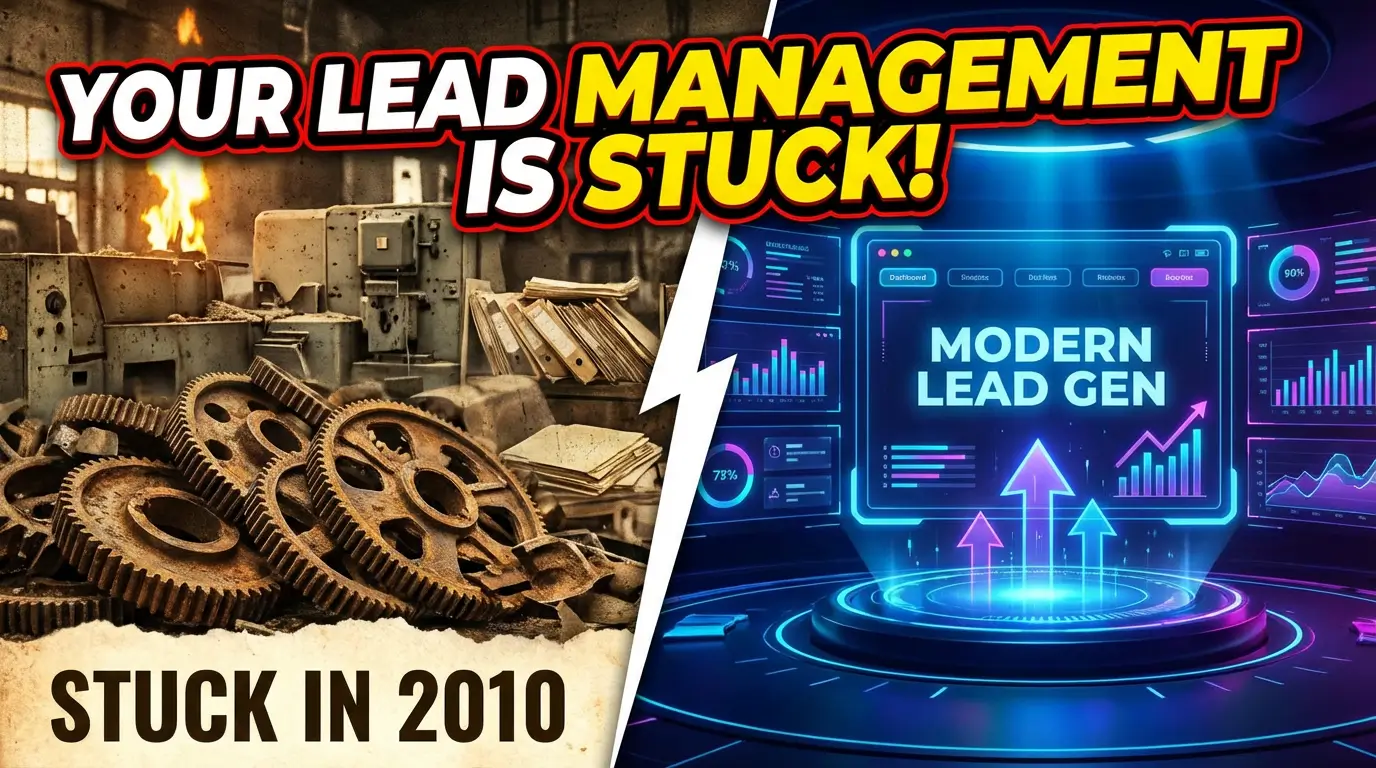
This isn’t a people problem. It’s a systems problem. And if your lead management still looks like a handoff from one department to another, you’re running a 2010 playbook in a world that moved on without you.
The Handoff Model Is Broken
The traditional model treated lead management like a relay race. Marketing generates the lead, qualifies it to some threshold, passes the baton to sales, and the job is done. Clean. Simple. Completely disconnected from how industrial buyers actually make purchasing decisions.
A recent analysis from MarTech put it directly: many organizations are “still attempting to solve 2026 problems with a 2010 mindset.” Lead management isn’t a single event or a handoff. It’s a lifecycle process that spans teams, platforms, and the entire revenue cycle.
For manufacturers, the stakes are higher than most B2B companies. Your sales cycles often stretch 6 to 18 months. Buying committees include engineers, procurement managers, quality directors, and C-suite executives who all evaluate your capabilities differently. A procurement officer wants pricing and delivery timelines. An engineer wants technical specifications and material certifications. The VP of Operations wants to know if you can scale when demand spikes.
Treating all of these stakeholders as a single “lead” moving through a linear funnel is like trying to machine a precision part with a sledgehammer. The tool doesn’t match the job.
What Actually Changed
Three things happened over the past decade that broke the old model for good.
Buyers went dark. According to Gartner, 75% of B2B buyers now complete most early-stage evaluation without any vendor interaction. They’re reading your case studies, checking your capabilities on your website, asking peers in Slack communities, and comparing you to competitors, all before they ever fill out a contact form. By the time your sales rep gets the lead, the buyer has already formed an opinion. If your lead management system only starts tracking at form submission, you’re blind to the most important part of the buying process.
Roles blurred. The neat division between “marketing generates, sales closes” doesn’t exist anymore. Sales reps run their own outreach campaigns on LinkedIn. Marketing pushes self-service buyers through to conversion without sales involvement. Customer success teams identify expansion opportunities. Highspot’s 2025 State of Sales Enablement Report found 47% of enterprise GTM teams struggle to deliver a strong customer experience for leads, and 41% find it challenging to provide timely, personalized engagement. That’s not a marketing problem or a sales problem. It’s a system that wasn’t designed for how work actually gets done now.
Data fragmented. The typical manufacturer runs an ERP for production, a CRM for sales, a marketing automation platform, maybe a separate system for service tickets, and spreadsheets duct-taping them all together. Critical context about a prospect, like the fact that they’ve been a service customer for five years and are now evaluating you for a new product line, lives in silos that don’t talk to each other. According to Modgility’s analysis of RevOps trends in manufacturing, leading manufacturers are moving toward total data unification, connecting ERP, CRM, and even IoT device data into a single source of truth that gives every team a complete picture of the customer.
Building the Modern Engine
So what does a lead management system actually look like when it’s built for the way manufacturing companies sell today? It’s not one tool or one process. It’s a set of connected capabilities that work together across your entire revenue cycle.
Start with definitions everybody agrees on. This sounds basic, and it is, which is why it’s shocking how many manufacturers skip it. What’s a lead? What’s an MQL? When does something become an SQL? If marketing and sales can’t agree on these terms, nothing downstream works. Sit in a room together (or on a call, at minimum) and hammer out definitions that both sides will actually use. Write them down. Put them in your CRM. Review them quarterly because your market changes and your definitions should change with it.
Score signals, not just demographics. Traditional lead scoring asked: What’s their title? How big is their company? What industry are they in? Those are table stakes. A modern scoring model layers in behavioral signals. Did they visit your capabilities page three times this week? Did they download a spec sheet for a product line you’re trying to grow? Did their company just announce a new facility build? Snovio’s 2026 lead generation data shows that B2B marketers are increasingly prioritizing lead quality over quantity, with 80% ranking high-quality leads as mission-critical. Quality comes from understanding intent, not just collecting contact information.
Intent data platforms like Bombora track content consumption patterns across thousands of B2B websites, surfacing signals about which companies are actively researching topics related to your products. As Reply.io’s analysis of intent signals explains, these tools help you prioritize in-market buyers and personalize outreach based on what prospects are actually researching right now, not what you hope they’re interested in.
Unify your data or accept the leaks. Every system that holds prospect data but doesn’t connect to your CRM is a leak in your pipeline. That trade show scanner app with 200 badge scans sitting on someone’s laptop? Leak. The service desk tickets that show a long-time customer asking about new capabilities? Leak. The ERP that knows a customer’s order volume dropped 30% last quarter, which nobody in sales has seen? Huge leak.
The fix isn’t buying another tool. It’s connecting the tools you already have. Manufacturers using HubSpot, Salesforce, or similar platforms need to integrate their ERP data, their marketing automation, and their service systems into a shared view. When your sales rep can see that a prospect downloaded a whitepaper, attended a webinar, AND their company just received a large government contract, that’s the kind of context that turns a cold call into a real conversation.
Build for multiple funnels, not one. The traditional marketing funnel assumes a linear progression: awareness to consideration to decision. Real buying behavior is messier. Some prospects come in hot from a referral and skip the top of your funnel entirely. Others browse your site for a year before engaging. Some start as service customers and evolve into new-product buyers.
Your lead management system needs to handle all of these paths. That means configuring different workflows for different entry points, not forcing every prospect through the same nurture sequence. A referred prospect from an existing customer doesn’t need your “Introduction to Precision Manufacturing” email series. They need a direct line to an engineer who can answer their specific technical questions.
Where AI Fits (and Where It Doesn’t)
AI is all over lead management conversations right now, and some of the applications are genuinely useful. Predictive lead scoring, for instance, can analyze thousands of data points to identify which prospects look most like your best existing customers. AI can help with demand forecasting by analyzing marketing engagement, sales pipeline data, and seasonal trends to predict future product interest. It can flag at-risk accounts by spotting behavioral patterns that suggest a customer might be about to leave.
But here’s what AI can’t do: it can’t fix bad data, unclear strategy, or misaligned teams. If your CRM is full of duplicate records and outdated contacts, an AI model trained on that data will produce confident-sounding garbage. If marketing and sales disagree on what constitutes a qualified lead, AI will just automate the disagreement faster.
The MarTech analysis nailed it: “Much of what has remained consistent over the last decade is still a fundamental requirement: you must get the basic plumbing in place before the cool AI stuff can truly scale.” Get your data clean. Get your definitions aligned. Get your systems connected. Then layer in AI where it adds real value.
Only-B2B’s 2026 marketing trends report makes a similar point: AI becomes a force multiplier only when thinking is already aligned. Teams with unclear positioning or misaligned goals experience faster failure with AI, not better results. The technology amplifies whatever you feed it, so feed it good inputs.
The Revenue Impact You’re Leaving on the Table
Let’s talk numbers, because manufacturers respond to numbers.
Snovio’s research pegs the average cost per lead across all B2B channels at $391.80. For manufacturing companies, where lead generation often involves trade shows, technical content development, and specialized outreach, that number is frequently higher. If you’re spending that much to acquire a lead and then losing it to a broken handoff or a data silo, you’re not just losing a lead. You’re losing the entire investment that brought that lead in.
The same research shows that lead nurturing increases sales opportunities by up to 10%. That’s not a trivial number when your average deal size is six or seven figures. A 10% increase in opportunities in the pipeline for a manufacturer doing $50 million in annual revenue could mean $5 million in additional pipeline.
And consider this: email remains the top-performing channel for B2B lead generation, with 32% of marketers naming it the most effective. But the average cold email response rate is just 5.1%. If your lead management system isn’t ensuring the right message reaches the right person at the right time in their buying process, that 5.1% drops even further. Personalization improves cold email conversion rates by 10%, according to the same data. But personalization requires context, and context requires unified data. It all connects.
What to Do Monday Morning
You don’t need to overhaul everything at once. Start with the highest-impact changes and build from there.
First, audit your lead definitions. Pull your marketing team and your top sales reps into a room. Ask them to independently write down what qualifies as an MQL and an SQL. Compare the answers. If they don’t match (they won’t), work together to create shared definitions. Document them. Put them where everyone can find them.
Second, map your data gaps. List every system that holds customer or prospect data. Note which ones connect to your CRM and which don’t. The disconnected ones are your biggest leaks. Pick one and integrate it this quarter.
Third, review your scoring model. If you’re still scoring leads only on demographics, add at least three behavioral signals: website visit frequency, content downloads, and email engagement. If you have the budget, evaluate an intent data provider like Bombora or ZoomInfo that can tell you when target accounts are researching topics you solve for.
Fourth, kill the linear funnel. Look at your last 20 closed deals and map how those buyers actually found you and moved through the process. You’ll likely find three or four distinct paths. Build workflows for each.
Fifth, get your service team into the loop. Your existing customers are your best source of new revenue. If your service team sees that a customer is asking about capabilities outside their current contract, that’s a sales signal. Make sure it gets to someone who can act on it.
The manufacturers who figure this out won’t just close more deals. They’ll build the kind of revenue engine that compounds over time, where every interaction with a prospect makes the next one more effective, and where no buyer slips through because nobody was paying attention.
Your pipeline is only as strong as the system behind it. And right now, for most manufacturers, that system is overdue for an upgrade.
Ready to stop losing leads to broken processes? Schedule a consultation and let’s build a lead management engine that matches how your buyers actually buy.