There’s a stat that should keep every manufacturing sales leader up at night.
According to 6Sense’s 2025 B2B Buyer Experience Report, 83% of B2B buyers mostly or fully define their purchase requirements before they ever speak to a salesperson. Not 50%. Not “some.” Eighty-three percent.
That means your prospect already knows what they need, has a shortlist of potential suppliers, and has probably talked to three of your competitors. By the time they fill out your contact form or pick up the phone, you’re not selling. You’re auditioning.
For manufacturers, this creates a massive problem. Most manufacturing companies still operate on a model where marketing generates “awareness” and sales closes deals through relationships and technical expertise. But that model assumes buyers want to talk to you early in the process. They don’t.
So what do you do when the buyer’s journey happens without you?
The old playbook is broken
Think about how most manufacturers generate leads today. Trade shows, distributor relationships, word-of-mouth referrals, and maybe some paid search. These channels aren’t dead, but they all share the same weakness: they’re reactive.
You set up a booth at IMTS or FABTECH. You wait for attendees to walk over. You scan their badge, send a follow-up email, and hope they remember you. Automation Alley reported this week that most manufacturers let their trade show leads die in spreadsheets and disconnected lead retrieval systems that never connect to ongoing marketing efforts.
Meanwhile, the buyer who actually needs your CNC machining capabilities or industrial coating services? They started their search on Google three months ago. They read comparison articles. They watched YouTube videos. They asked peers in LinkedIn groups and industry forums who they’d recommend. Corporate Visions’ 2026 analysis of B2B buying behavior found that 73% of B2B marketing executives rank word-of-mouth and peer recommendations as the most influential factor in vendor selection.
Your buyer did all of that research, formed an opinion, and narrowed their list. Then they contacted you. If they contacted you at all.
The buying committee problem is getting worse
Manufacturing purchases aren’t impulse buys. A new stamping press, a materials supplier contract, an MES system implementation. These decisions involve multiple people, multiple budgets, and real operational risk.
According to 6Sense’s latest data, typical B2B purchases now involve teams of about 10 people. That’s not a typo. Ten stakeholders with different priorities, different risk tolerances, and different definitions of success. Demandbase’s 2025 research found that 72% of B2B purchases involve high-complexity buying groups spanning multiple functions: engineering, operations, finance, procurement, and end users.
And it gets worse. TrustRadius reported in 2024 that 79% of these purchases now require CFO approval. Your champion on the plant floor might love your solution, but they still need to convince finance, IT, operations leadership, and possibly a procurement team that specializes in saying no.
What this means for your lead generation is simple but uncomfortable: capturing a single contact name isn’t enough. You need to reach and influence multiple people inside the same account, often before any of them are ready to talk to you.
Your website is leaking leads right now
Here’s where the math gets painful.
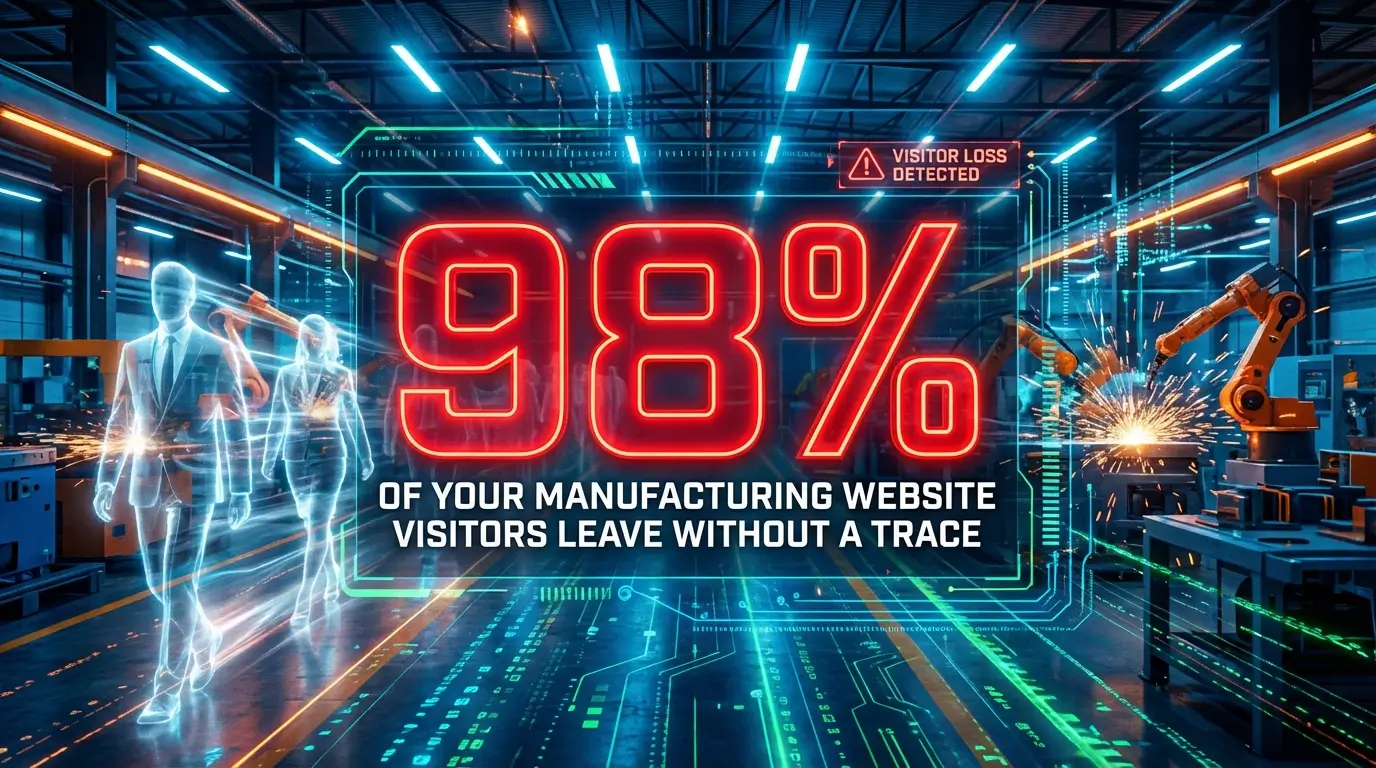
Leadinfo’s 2026 B2B lead generation analysis puts the average B2B website conversion rate at 2%. That means 98 out of every 100 companies that visit your website leave without filling out a form, requesting a quote, or making any identifiable contact.
They came. They looked at your capabilities page, your equipment list, maybe your certifications. They compared you to two other shops. And they left.
For a manufacturer spending money on SEO, paid search, or content marketing to drive traffic, that’s a brutal number. You paid to get those visitors to your site and 98% of them vanished.
This is where the market is shifting fast. Visitor identification tools like ZoomInfo’s WebSights, Lead Forensics, and Leadinfo can identify which companies are visiting your website even when individual visitors don’t fill out a form. They match IP addresses and behavioral signals to company profiles, giving you the company name, industry, size, and which pages they viewed.
It’s not magic. It’s first-party intent data. And for manufacturers, it changes the game.
Picture this: a tier-one automotive supplier visits your website, spends time on your precision machining page, looks at your ISO certifications, and checks your location. Without visitor identification, that’s just another anonymous session in Google Analytics. With it, your sales team gets an alert and can reach out the same day with context about exactly what that company was researching.
Intent data is the new trade show badge scan
The concept is straightforward. Instead of waiting for buyers to identify themselves (the form fill, the phone call, the trade show conversation), you identify buying signals from their behavior and act on them proactively.
The B2B lead generation service market is growing at a 9.3% CAGR through 2033, according to DataHorizzon Research, driven largely by this shift toward intent-based prospecting. The market was valued at $5.7 billion in 2024 and is projected to reach $13.8 billion by 2033.
For manufacturers specifically, intent data solves a problem that’s always been hard: knowing who’s in-market right now. Your sales team has a finite number of hours. Calling through a list of 500 companies that might need your services someday is a terrible use of their time. Calling the 12 companies that visited your capabilities page this week? That’s a different conversation entirely.
But intent data only works if you have something worth visiting. Which brings us to the content problem.
Most manufacturing websites are invisible to modern buyers
94% of B2B buyers now use large language models during their buying process, according to 6Sense. 72% encounter Google’s AI Overviews during research, and 90% click through to at least one cited source.
This is where generative engine optimization (GEO) enters the picture for manufacturers. It’s not enough to rank on Google anymore. Your content needs to be structured, factual, and authoritative enough that AI systems cite it as a source. Leadinfo’s analysis calls this “zero-click content” and notes that after seeing an AI Overview, only 8% of users click through to a website.
For a manufacturer, this means your website content strategy needs a fundamental rethink. Product spec sheets and “About Us” pages aren’t enough. You need content that answers the questions your buyers are actually asking during their research phase:
What tolerances can a 5-axis CNC machine hold on titanium parts? How do you qualify a new metal finishing supplier for aerospace applications? What’s the real cost difference between domestic and offshore injection molding for runs under 10,000 parts?
If your website answers those questions with real expertise and specific data, two things happen. First, AI systems start citing your content, putting your brand in front of buyers before they even visit your site. Second, when those buyers do visit, they already see you as a credible source, not just another vendor.
Demand generation before lead capture
Snov.io’s 2026 lead generation statistics show that B2B marketers allocate 37% of their marketing budgets to lead generation, making it the single largest spending category. But there’s a growing tension between gating content behind forms and making it freely available.
The old approach: write a whitepaper, put it behind a form, collect email addresses, blast those addresses with nurture emails. It worked when buyers had no other way to access information.
That world doesn’t exist anymore. Buyers can find most of what they need through Google, AI tools, peer networks, and review sites. Only 9% of buyers consider vendor websites reliable sources of information, according to G2’s 2024 research. Gating your content doesn’t make it more valuable. It just sends buyers to your competitor who published the same information without a gate.
The smarter play for manufacturers: publish your best content freely. Let engineers and procurement managers consume it on their own terms. Then use visitor identification to see which companies are engaging with that content. You get the intelligence without the friction.
This is the shift from lead generation to demand generation that’s reshaping B2B marketing. Create demand first by being genuinely helpful. Capture leads second by tracking who’s paying attention.
What this means for your manufacturing company
If you’re a contract manufacturer, OEM, or industrial supplier, here’s the uncomfortable truth: the companies beating you to deals aren’t necessarily better at manufacturing. They’re better at being found and being relevant during the 83% of the buying journey that happens before anyone picks up the phone.
Fixing this doesn’t require a massive budget. It requires a different mindset.
Start by auditing your website through the lens of a buyer who’s 70% through their research. Does your site answer their specific technical questions? Can they find case studies that match their industry? Can they compare your capabilities to alternatives without having to call you? If the answer to any of those is no, you’re losing deals you never knew existed.
Then look at what happens when companies do visit your site. Are you tracking that traffic beyond basic Google Analytics? Can your sales team see which companies are researching your capabilities this week? If not, you’re leaving the most valuable sales intelligence on the table.
The B2B buying process has changed. Your buyers have already adapted. The question is whether your lead generation will catch up before your competitors’ does.
Need help rethinking your manufacturing lead generation strategy? Book a free consultation and we’ll audit your current approach against what modern B2B buyers actually expect.