If you’re a manufacturer still relying almost entirely on trade shows and cold calls to fill your pipeline, you’re leaving a massive amount of money on the table.
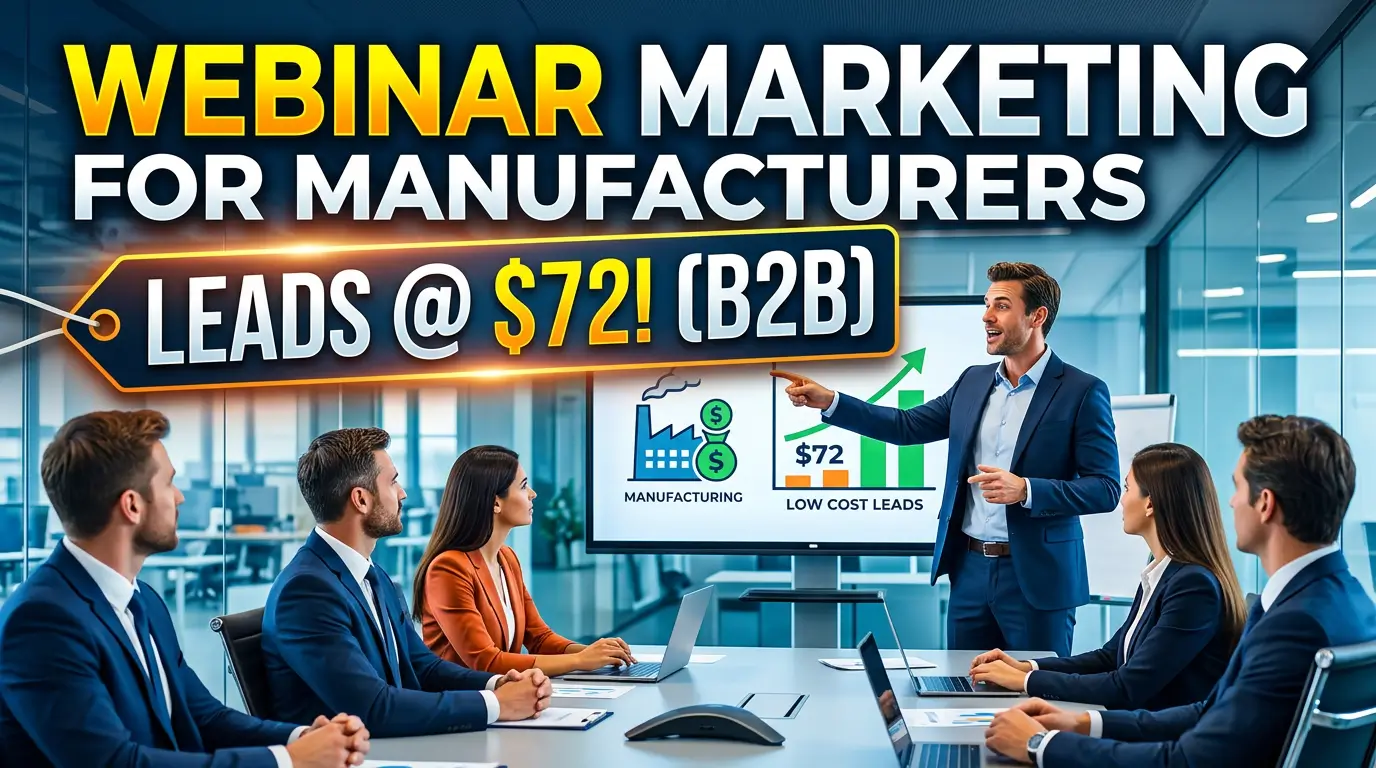
According to research compiled by Teleprompter.com, the average cost per lead from a webinar is around $72. Compare that to in-person trade shows, which routinely exceed $800 per lead once you factor in booth rental, travel, shipping, and staff time. That’s not a small gap — that’s a 10x difference in cost efficiency.
And yet most manufacturers still haven’t touched webinars. That’s actually good news if you’re reading this. You can get ahead of your competitors before the channel gets crowded.
This guide breaks down exactly how manufacturers can use webinar marketing to generate consistent, high-intent B2B leads — from picking the right topics to running the event and following up in a way that converts.
Why Webinars Work Especially Well for Manufacturers
Manufacturing sales are not impulse decisions. A prospect evaluating a new CNC machine supplier, a packaging partner, or a precision parts manufacturer is typically navigating a 6-to-12-month buying cycle with multiple stakeholders involved.
That dynamic makes webinars a near-perfect fit. Here’s why:
They filter for serious buyers. Someone who registers for a 45-minute webinar titled “How to Reduce Scrap Rates in High-Mix Low-Volume Production” is not a casual browser. They have a real problem. They’ve invested time. That’s buyer intent you simply don’t get from a blog post or a LinkedIn ad click.
They let you demonstrate expertise. In manufacturing, trust is everything. Buyers want to work with people who know their industry. A well-run webinar — where your engineers, application specialists, or operations leaders walk through real challenges and real solutions — signals credibility in a way no brochure can.
They scale what doesn’t normally scale. A top sales engineer can only do so many in-person visits per week. A webinar lets that same expert reach 50, 100, or 200 qualified prospects simultaneously, without a travel budget.
The numbers back this up. According to ON24’s 2025 Digital Engagement Benchmarks Report, webinars achieve an average 213% ROI. And Goldcast’s 2025 B2B Webinar Benchmark Report, which analyzed 19,531 webinars across 418 brands, found that 78% of marketers report webinars lower their overall cost-per-lead compared to other channels.
What Topics Actually Work for Manufacturing Webinars
The most common mistake manufacturers make is picking topics that are too broad or too promotional. “Our Products and Services” is not a webinar. It’s a sales pitch with no audience.
The best manufacturing webinars are intensely specific and educational. They solve a real problem your buyers are wrestling with right now. Here are proven topic categories that generate strong registrations:
Process improvement and cost reduction. Topics like “5 Ways to Cut Lead Times Without Adding Capacity” or “How to Reduce Material Waste in Sheet Metal Fabrication” attract operations and engineering buyers who are actively under pressure to improve performance. These are exactly the people who influence purchase decisions.
Regulatory and compliance guidance. If your industry has relevant standards — AS9100, IATF 16949, FDA compliance for food-grade manufacturing — a webinar explaining how to navigate those requirements positions you as a trusted advisor, not just a vendor.
Technology and automation. “What Manufacturers Need to Know Before Investing in Robotics” or “A Practical Guide to IIoT for Small and Mid-Size Shops” attracts a forward-thinking audience that’s actively researching solutions. These prospects are in research mode — the ideal time to get in front of them.
Customer success formats. A structured case study webinar — “How [Customer Name] Reduced Downtime by 40% Using [Your Process/Product]” — provides social proof while educating. Just keep it educational, not a commercial.
Industry trends and market intelligence. Quarterly or semi-annual state-of-the-industry webinars attract a broad audience and can establish your brand as a thought leader over time.
The common thread: your topic should answer a question your buyers are already asking. Talk to your sales reps. What objections come up on every call? What questions do prospects ask during site visits? Those are your webinar topics.
The Content Marketing Institute’s 2025 B2B research found that webinars are cited by 51% of B2B content marketers as their best-performing content format. But results like that don’t happen by accident — they require a deliberate promotion plan.
Start promotion three to four weeks out. According to ON24 benchmark data, the most successful webinars begin promotion at least 15 days in advance. Give your audience time to plan around the event.
Email is your most powerful driver. Research shows that 57% to 70% of webinar registrations come from email, making it far more effective than social media for registrations. If you have a list — even a small one — segment it carefully and send a personalized invitation that speaks to the specific pain point your webinar addresses.
Use LinkedIn for reach. For manufacturing B2B, LinkedIn is the right social channel. Promote the webinar through your company page and encourage your sales team to share it personally. Feature the speaker’s name and credentials prominently — decision-makers respond to peer expertise.
Create a tight registration page. Keep the form short: name, company, title, email, and maybe one qualifying question (like “What’s your biggest challenge with X right now?”). That question pre-qualifies leads and gives your sales team intel for follow-up.
Send reminder emails. A 48-hour reminder and a same-day reminder significantly improve attendance rates. ON24 data shows registration-to-attendance rates of 40–57% for B2B webinars — your reminders directly influence where you land in that range.
Running a Webinar That Actually Converts
Getting people registered is half the battle. Getting them to show up, stay engaged, and take a next step is where the real work happens.
Keep the core presentation to 40–45 minutes. Research shows 44% of B2B attendees prefer 45-minute webinars, and average watch time hovers around 50 minutes for well-run sessions. Front-load your most valuable content — don’t build to a big reveal at the 35-minute mark.
Build in interaction from the start. Use a poll in the first three minutes. Something like: “What’s your biggest production challenge right now? [A] Lead times, [B] Scrap and rework, [C] Finding skilled labor, [D] Capacity planning.” Polls do two things: they keep attendees engaged, and they give you segmentation data you can use in follow-up. Goldcast data shows that high-engagement webinars achieve 69% CTA conversion rates — compared to just 22% average — and interaction is a key driver of that gap.
Reserve 10–15 minutes for live Q&A. 92% of B2B webinar attendees say a live Q&A is essential. This is also where real sales conversations start. When someone asks a detailed question about a specific application or challenge, that’s a signal your sales team should follow up on personally.
Include a single, clear call to action. Don’t try to sell everything at once. Pick one next step that’s appropriate for where your buyers are: “Schedule a 30-minute application review,” “Download our process audit checklist,” or “Request a sample.” Make it easy and specific.
Record everything. On-demand views are substantial — approximately 45% of all webinar consumption now happens post-event. Your gated recording becomes a lead generation asset that keeps working for months after the live event.
The Follow-Up Sequence That Closes Deals
This is where most manufacturers drop the ball. They run a decent webinar, collect a bunch of registrations, and then send one generic “thank you” email. That’s leaving most of your leads to go cold.
The right approach is to segment your follow-up by engagement level.
Attendees who stayed 30+ minutes and asked questions: These are your hottest leads. Within 24 hours, have a sales rep reach out personally — not a template, a personalized note that references something they asked or engaged with during the webinar. These are people who showed sustained interest. Treat them accordingly.
Attendees who joined but dropped off early: Send the recording link with a brief note acknowledging they may not have caught everything. Include a one-sentence CTA. These leads are warm but not hot — put them into a nurture sequence.
Registrants who didn’t attend: Don’t write these off. Many registered with intent and simply got pulled into a meeting. Send the recording within 24 hours, acknowledge that they missed the live session, and offer a simple next step. 89% of webinar leads come from live attendees, but registrants-who-became-replay-viewers are still far warmer than cold contacts.
The nurture sequence for all non-converted leads: This is a 4–6 email sequence delivered over 6–8 weeks, each providing additional value connected to the webinar topic. A related blog post. A technical guide. A brief case study. A benchmark report. The goal is to keep your brand top of mind until they’re ready to have a sales conversation.
Remember: according to B2B marketing research from Root Digital, the average time from lead to conversion in B2B is 84 days. A single follow-up email isn’t enough. You need a system.
Repurposing Your Webinar for Maximum ROI
A webinar isn’t a one-time event — it’s a content asset you can repurpose across every channel.
Here’s what you can extract from a single 45-minute webinar:
- A long-form blog post summarizing the key takeaways (which also helps with SEO for the topic)
- 3–5 short video clips (60–90 seconds each) for LinkedIn, pulled from the most insight-dense moments
- An infographic visualizing the key framework or process you covered
- A downloadable checklist or guide based on the step-by-step content
- Email content for 2–3 newsletter issues or nurture emails
- Talking points for your sales team to use in prospect conversations
Goldcast’s 2025 report found that content repurposing from webinars saved marketers an estimated $520,000 in production time in 2024 alone. For a small or mid-size manufacturer with a lean marketing team, that kind of efficiency multiplier is significant.
Getting Started: A 90-Day Webinar Launch Plan
If you’ve never run a manufacturing webinar before, here’s a realistic 90-day framework to get your first series off the ground.
Days 1–30 (Planning): Choose your first topic based on your most common sales conversation. Set a date 4–5 weeks out. Identify the internal speaker(s) — ideally a technical expert who can speak with authority, not just a marketer. Select a platform (Zoom Webinars, ON24, or GoToWebinar all work well). Build your registration page.
Days 31–60 (Promotion): Send your invitation sequence to your email list. Promote on LinkedIn. Brief your sales team so they can personally invite prospects they’re nurturing. Prepare your slides and run a rehearsal with the speaker.
Day of Webinar: Go live. Run the polls. Take questions. Close with a clear CTA.
Days After (Follow-Up and Repurposing): Deploy your segmented follow-up sequences within 24 hours. Begin repurposing the recording into derivative content. Review your registration, attendance, and engagement data to optimize for next time.
Month 3: Run your second webinar with the lessons from the first baked in. Webinars compound — your second one will outperform your first, and your sixth will outperform your second.
The Bottom Line
Manufacturing buyers are more skeptical, more technical, and more cautious than almost any other B2B audience. That’s exactly why webinars work so well for this industry. When you show up as a genuine expert, solve real problems, and give buyers a low-risk way to engage with your company before they’re ready to buy, you build the kind of trust that eventually turns into long-term contracts.
And you do it at $72 per lead instead of $800.
If you’re ready to build a webinar strategy that actually generates pipeline for your manufacturing business, schedule a free consultation and we’ll map out a plan specific to your company and your buyers.
Sources: ON24 2025 Digital Engagement Benchmarks Report · Goldcast 2025 B2B Webinar Benchmark Report · Teleprompter.com Webinar Statistics 2025 · Content Marketing Institute B2B Research 2025 · Root Digital B2B Marketing Statistics