MIG Welding Solutions for Every Industry
MIG welding (GMAW) feeds a consumable wire electrode through a welding gun to produce fast, efficient welds on steel, aluminum, and other metals for production applications.
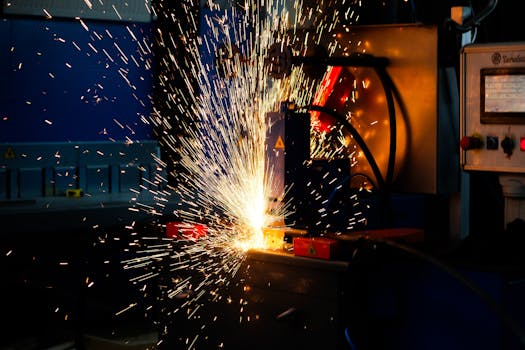
About MIG Welding
MIG welding, formally known as Gas Metal Arc Welding (GMAW), is a semi-automatic or automatic arc welding process that feeds a continuous solid or tubular wire electrode through a welding gun. A shielding gas (typically argon/CO2 mixture for steel, pure argon for aluminum) protects the weld pool. MIG welding is the most widely used industrial welding process due to its versatility, speed, and ease of automation. It is significantly faster than TIG welding and can be used on a wide range of material thicknesses from 24 gauge sheet metal to heavy structural plates. Robotic MIG welding is standard in automotive manufacturing and high-volume fabrication.
Tolerances
±0.015"-±0.030" typical; robotic MIG improves consistency
Lead Time
3-10 business days for prototypes; 2-6 weeks for production
Cost Range
$60-$150/hour; generally lower cost than TIG per foot of weld
Compatible Materials
Advantages
- Fast welding speed
- Easy to learn and operate
- Excellent for automation/robotics
- Works on thin to thick materials
- High deposition rate
- All-position welding capability
Limitations
- Lower weld quality than TIG
- More spatter than TIG
- Wind-sensitive (outdoor use challenging)
- Less control on very thin materials
- Gas shielding must be maintained
Industries Served
Automotive
The automotive industry manufactures vehicles and components, demanding high-volume production, consistent quality, and competitive pricing across a complex global supply chain.
Defense & Military
The defense industry manufactures weapons systems, vehicles, equipment, and components for military applications, requiring the highest security, reliability, and quality standards.
Construction
Construction manufacturing produces structural steel, rebar, building components, HVAC systems, and architectural elements for commercial and residential buildings.
Agriculture
Agricultural manufacturing produces tractors, harvesters, irrigation systems, and precision farming equipment that must withstand harsh outdoor conditions and heavy use.
Marine
Marine manufacturing produces vessels, propulsion systems, and offshore structures that must withstand saltwater corrosion, high loads, and demanding marine environments.
MIG Welding FAQ
Is MIG welding stronger than TIG welding?
Both processes can produce full-strength welds. The strength depends on proper technique, parameters, and filler metal — not the process itself. TIG often produces higher-quality welds with fewer defects, but a properly executed MIG weld is equally strong.
What gas is used for MIG welding?
For carbon steel, 75% argon / 25% CO2 (C25) is most common. Pure CO2 is cheaper but produces more spatter. For aluminum, pure argon is used. For stainless steel, tri-mix (helium/argon/CO2) or 98% argon / 2% CO2 is common.
Can MIG welding be used on aluminum?
Yes, MIG welding aluminum is common using a spool gun or push-pull gun system with pure argon shielding gas. It is faster than TIG welding aluminum and preferred for thicker sections and production environments.
What is the difference between MIG and flux-cored welding?
Standard MIG uses solid wire and external shielding gas. Flux-cored welding uses tubular wire with flux inside that generates its own shielding gas (self-shielded) or is used with external gas (dual-shielded). Flux-cored is better for outdoor use and thicker materials.
How fast is robotic MIG welding?
Robotic MIG welding achieves travel speeds of 30-80+ inches per minute, compared to 10-20 inches per minute for manual welding. Combined with consistent quality and minimal downtime, robotic MIG cells can be 3-5x more productive than manual operations.
Need More MIG Welding Customers?
Tell us about your manufacturing capabilities and we'll show you exactly how to attract qualified buyers. No obligation.
Tell Us About Your MIG Welding Needs →