Professional Grinding Services for Your Business
Grinding uses abrasive wheels to remove small amounts of material with extreme precision, achieving tight tolerances and superior surface finishes on hardened metals.
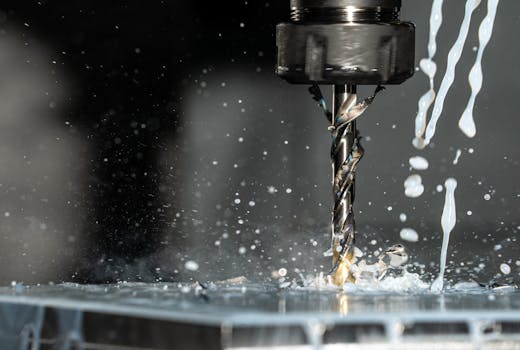
About Grinding
Grinding is a precision abrasive machining process that uses a rotating grinding wheel to remove material from a workpiece. The grinding wheel consists of abrasive grains (aluminum oxide, silicon carbide, CBN, or diamond) bonded together in a matrix. Grinding is typically used as a finishing operation after heat treatment, achieving tolerances that are difficult or impossible with conventional machining. Types of grinding include surface grinding (flat surfaces), cylindrical grinding (round parts), centerless grinding (high-volume round parts), internal grinding (bores), and creep-feed grinding (deep profile cuts). Grinding is essential for producing precision gears, bearings, shafts, cutting tools, and any component requiring tight tolerances and smooth surfaces.
Tolerances
±0.0001"-±0.0005" (±0.003-0.013mm) achievable
Lead Time
3-10 business days
Cost Range
$75-$175/hour; $20-$500+ per part
Compatible Materials
Advantages
- Extremely tight tolerances
- Superior surface finish (4-16 Ra)
- Machines hardened materials (60+ Rc)
- Excellent dimensional accuracy
- Consistent and repeatable
- Multiple grinding types for different geometries
Limitations
- Slow material removal rate
- Limited to small stock removal
- Grinding wheel wear affects accuracy
- Heat generation can affect surface integrity
- Specialized fixturing often required
- Higher cost than turning/milling for soft materials
Industries Served
Aerospace
The aerospace industry manufactures aircraft, spacecraft, satellites, and related components requiring the highest standards of precision, quality, and reliability.
Automotive
The automotive industry manufactures vehicles and components, demanding high-volume production, consistent quality, and competitive pricing across a complex global supply chain.
Medical Devices
The medical device industry manufactures instruments, implants, diagnostics, and equipment that must meet stringent regulatory requirements for safety and biocompatibility.
Defense & Military
The defense industry manufactures weapons systems, vehicles, equipment, and components for military applications, requiring the highest security, reliability, and quality standards.
Grinding FAQ
When is grinding necessary?
Grinding is necessary when parts require tolerances tighter than ±0.001", surface finishes better than 32 Ra microinches, or when material is too hard for conventional machining (heat-treated steel above 40 Rc). It is a finishing process, not a bulk material removal process.
What surface finish can grinding achieve?
Grinding achieves surface finishes of 4-32 Ra microinches (0.1-0.8 Ra μm) depending on the process and parameters. Mirror-finish grinding can achieve 1-2 Ra microinches. This is significantly smoother than as-machined surfaces (32-125 Ra).
What is centerless grinding?
Centerless grinding supports the workpiece between a grinding wheel, a regulating wheel, and a work rest blade — without centers or chucks. It is extremely efficient for high-volume production of cylindrical parts like pins, shafts, rollers, and needles.
Can grinding replace other machining operations?
Creep-feed grinding can perform deep cuts similar to milling, useful for hard materials. However, grinding is generally used as a finishing operation after turning, milling, or heat treatment. It is rarely the most efficient process for bulk material removal.
What causes grinding burn?
Grinding burn occurs when excessive heat generation changes the surface metallurgy — typically re-hardening or softening the steel surface. It reduces fatigue life and can cause cracking. Prevention includes proper wheel selection, dress frequency, coolant flow, and conservative feed rates.
Need More Grinding Customers?
Tell us about your manufacturing capabilities and we'll show you exactly how to attract qualified buyers. No obligation.
Tell Us About Your Grinding Needs →