CNC Turning Solutions for Every Industry
CNC turning rotates a workpiece on a lathe while cutting tools shape it into cylindrical parts with high precision. It is ideal for creating shafts, pins, bushings, and other round components.
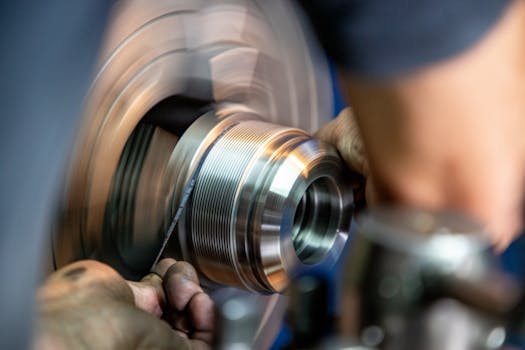
About CNC Turning
CNC turning is a machining process in which a bar of material is held in a chuck and rotated while a cutting tool is fed into the workpiece to remove material and create the desired shape. CNC lathes and turning centers can produce parts with external and internal features including straight turning, taper turning, threading, grooving, facing, and boring. Modern CNC turning centers often include live tooling capabilities, allowing milling, drilling, and tapping operations to be performed in the same setup, dramatically reducing cycle times and improving accuracy.
Tolerances
±0.001" (±0.025mm) standard; ±0.0005" achievable
Lead Time
3-10 business days for prototypes; 3-6 weeks for production
Cost Range
$30-$300 per part for prototypes; volume pricing lower
Compatible Materials
Advantages
- Excellent for cylindrical parts
- High production rates
- Great surface finish on round features
- Live tooling adds milling capability
- Cost-effective for round components
- Minimal setup for simple geometries
Limitations
- Primarily limited to round/cylindrical geometries
- Complex non-round features require additional operations
- Part size limited by lathe swing diameter
- Deep bore operations can be challenging
Industries Served
Aerospace
The aerospace industry manufactures aircraft, spacecraft, satellites, and related components requiring the highest standards of precision, quality, and reliability.
Automotive
The automotive industry manufactures vehicles and components, demanding high-volume production, consistent quality, and competitive pricing across a complex global supply chain.
Medical Devices
The medical device industry manufactures instruments, implants, diagnostics, and equipment that must meet stringent regulatory requirements for safety and biocompatibility.
Defense & Military
The defense industry manufactures weapons systems, vehicles, equipment, and components for military applications, requiring the highest security, reliability, and quality standards.
Oil & Gas
The oil and gas industry requires specialized manufacturing for drilling equipment, pipelines, valves, pumps, and refinery components that withstand extreme pressures and corrosive environments.
Electronics
The electronics manufacturing industry produces circuit boards, components, enclosures, and assemblies for computing, communications, industrial controls, and consumer devices.
CNC Turning FAQ
What parts are made with CNC turning?
CNC turning produces cylindrical and round parts including shafts, pins, bushings, connectors, fittings, spacers, collets, rollers, and threaded components. It's essential for any part with rotational symmetry.
What is the difference between CNC turning and CNC milling?
In CNC turning, the workpiece rotates while the cutting tool remains relatively stationary. In CNC milling, the cutting tool rotates while the workpiece remains stationary. Turning excels at round parts; milling excels at flat surfaces and complex 3D shapes.
How fast is CNC turning production?
CNC turning is one of the fastest machining processes. Simple parts can be produced in under a minute per piece. With bar feeders and automation, CNC lathes can run unattended for hours, producing hundreds or thousands of parts per shift.
Can CNC turning create threaded parts?
Yes, CNC turning is excellent for creating both internal and external threads. Thread cutting on a CNC lathe produces precise, consistent threads including standard, metric, ACME, and custom thread forms.
What surface finish can CNC turning achieve?
CNC turning typically achieves surface finishes of 32-63 Ra microinches (0.8-1.6 Ra μm) as-machined. With fine finishing passes, finishes of 16 Ra microinches (0.4 Ra μm) or better are achievable.
Need More CNC Turning Customers?
Tell us about your manufacturing capabilities and we'll show you exactly how to attract qualified buyers. No obligation.
Tell Us About Your CNC Turning Needs →