5-Axis Machining Solutions for Every Industry
5-axis machining moves a cutting tool along five axes simultaneously, enabling the creation of extremely complex parts in a single setup with superior precision and surface quality.
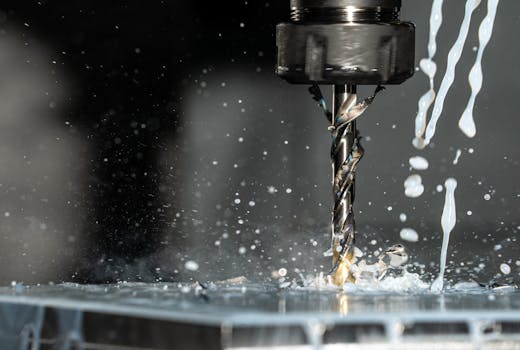
About 5-Axis Machining
5-axis CNC machining is an advanced manufacturing process where the cutting tool moves simultaneously along five different axes. Beyond the traditional X, Y, and Z linear axes, 5-axis machines add two rotational axes (typically A and B, or B and C). This capability allows the cutting tool to approach the workpiece from virtually any direction, enabling the machining of complex geometries, deep cavities, and undercut features that would be impossible or require multiple setups on a 3-axis machine. 5-axis machining is critical for aerospace components like turbine blades, impellers, and structural airframe parts, as well as complex medical implants and precision molds.
Tolerances
±0.0005" (±0.013mm) standard; ±0.0002" achievable
Lead Time
5-20 business days for prototypes; 6-12 weeks for production
Cost Range
$200-$2,000+ per part; highly dependent on complexity
Compatible Materials
Advantages
- Machine complex geometries in single setup
- Superior surface finish on contoured surfaces
- Reduced setups mean higher accuracy
- Ability to machine undercuts and deep cavities
- Shorter cycle times for complex parts
- Better tool life with optimal tool angles
Limitations
- Higher machine and operating costs
- Complex programming required
- Requires skilled operators and programmers
- Higher maintenance costs
- Not cost-effective for simple parts
Industries Served
Aerospace
The aerospace industry manufactures aircraft, spacecraft, satellites, and related components requiring the highest standards of precision, quality, and reliability.
Automotive
The automotive industry manufactures vehicles and components, demanding high-volume production, consistent quality, and competitive pricing across a complex global supply chain.
Medical Devices
The medical device industry manufactures instruments, implants, diagnostics, and equipment that must meet stringent regulatory requirements for safety and biocompatibility.
Defense & Military
The defense industry manufactures weapons systems, vehicles, equipment, and components for military applications, requiring the highest security, reliability, and quality standards.
5-Axis Machining FAQ
When is 5-axis machining necessary?
5-axis machining is necessary for parts with complex contoured surfaces, undercuts, deep cavities, or features on multiple faces that would require numerous setups on a 3-axis machine. Common examples include turbine blades, impellers, aerospace structural components, and complex medical implants.
Is 5-axis machining more expensive?
5-axis machining has higher hourly rates ($100-$200+/hr vs. $75-$125/hr for 3-axis). However, for complex parts, the total cost is often lower because parts are completed in a single setup, eliminating fixture changes, reducing error, and cutting cycle time.
What industries use 5-axis machining the most?
Aerospace is the largest user of 5-axis machining, followed by medical devices, defense, energy (turbine components), and automotive (motorsport and luxury). Any industry requiring complex precision components benefits from 5-axis capabilities.
What is the difference between 3+2 axis and full 5-axis machining?
In 3+2 axis machining, the rotary axes position the workpiece at a fixed angle, then machining proceeds using 3 axes. Full simultaneous 5-axis machining moves all five axes at once, enabling smooth contoured surfaces. Full 5-axis is needed for complex sculpted surfaces like turbine blades.
How complex of a part can 5-axis machining produce?
5-axis machining can produce virtually any geometry that can be reached by a cutting tool, including complex organic shapes, deep pockets with draft angles, helical features, and multi-sided parts. The main limitation is tool reach and workpiece size.
Need More 5-Axis Machining Customers?
Tell us about your manufacturing capabilities and we'll show you exactly how to attract qualified buyers. No obligation.
Tell Us About Your 5-Axis Machining Needs →