3D Printing / Additive Manufacturing Solutions for Every Industry
3D printing builds parts layer by layer from digital models, enabling rapid prototyping, complex geometries, and on-demand production without traditional tooling.
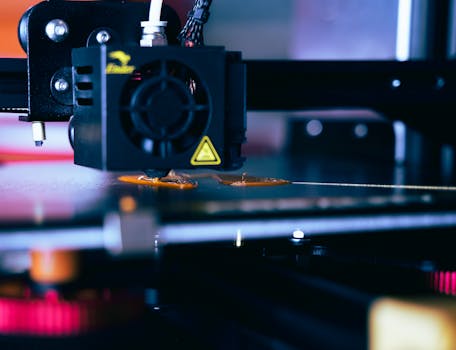
About 3D Printing / Additive Manufacturing
3D printing, also known as additive manufacturing, builds three-dimensional objects by depositing material layer by layer based on digital 3D model data. Unlike subtractive manufacturing (machining) which removes material, additive manufacturing adds material only where needed, reducing waste and enabling geometries impossible with traditional methods. Technologies include Fused Deposition Modeling (FDM), Stereolithography (SLA), Selective Laser Sintering (SLS), Direct Metal Laser Sintering (DMLS), and Multi Jet Fusion (MJF). 3D printing has evolved from purely a prototyping tool to a production manufacturing process for aerospace, medical, dental, automotive, and consumer products.
Tolerances
±0.005"-±0.010" (±0.13-0.25mm) typical; varies by technology
Lead Time
1-5 business days for prototypes; 1-4 weeks for production
Cost Range
$5-$500+ per part for prototypes; $10-$1,000+ for metal parts
Compatible Materials
Advantages
- No tooling required
- Rapid prototyping (hours to days)
- Complex internal geometries
- Low-volume production economical
- Design iteration is fast and cheap
- On-demand manufacturing possible
Limitations
- Slower than traditional manufacturing at volume
- Limited material selection vs. machining
- Surface finish requires post-processing
- Part strength may be anisotropic (directional)
- Build size limitations
- Higher per-part cost at volume vs. molding
Industries Served
Aerospace
The aerospace industry manufactures aircraft, spacecraft, satellites, and related components requiring the highest standards of precision, quality, and reliability.
Automotive
The automotive industry manufactures vehicles and components, demanding high-volume production, consistent quality, and competitive pricing across a complex global supply chain.
Medical Devices
The medical device industry manufactures instruments, implants, diagnostics, and equipment that must meet stringent regulatory requirements for safety and biocompatibility.
Defense & Military
The defense industry manufactures weapons systems, vehicles, equipment, and components for military applications, requiring the highest security, reliability, and quality standards.
Consumer Products
Consumer products manufacturing produces household goods, appliances, sporting equipment, and personal items through high-volume processes prioritizing aesthetics and cost efficiency.
3D Printing / Additive Manufacturing FAQ
When should I use 3D printing vs. CNC machining?
Use 3D printing for complex internal geometries, rapid prototyping (1-5 parts), lightweight lattice structures, and parts that would require significant machining setup. Use CNC machining for tight tolerances, better surface finish, stronger material properties, and medium-to-high volumes.
What is the strongest 3D printing material?
For plastics, PEEK and carbon-fiber-filled nylon offer the highest strength. For metals, titanium Ti-6Al-4V and Inconel 718 printed via DMLS/SLM achieve properties comparable to wrought material after heat treatment. Metal 3D printing is used for flight-critical aerospace components.
How accurate is 3D printing?
Accuracy varies by technology. SLA achieves ±0.002"-±0.005". SLS achieves ±0.005"-±0.010". FDM achieves ±0.010"-±0.020". Metal DMLS achieves ±0.003"-±0.005". For precision applications, post-machining of critical features is common.
Can 3D printed parts be used in production?
Yes, 3D printing is increasingly used for end-use production parts. Aerospace uses metal 3D printing for fuel nozzles and brackets. Medical uses it for custom implants. Dental uses it for aligners and crowns. Automotive uses it for jigs, fixtures, and low-volume components.
How much does 3D printing cost?
Costs depend on material, technology, size, and quantity. Simple FDM parts start at $5-$20. SLS nylon parts range from $20-$100. Metal 3D printing ranges from $100-$1,000+ per part. For comparison, a CNC machined prototype might cost $100-$500.
Need More 3D Printing / Additive Manufacturing Customers?
Tell us about your manufacturing capabilities and we'll show you exactly how to attract qualified buyers. No obligation.
Tell Us About Your 3D Printing / Additive Manufacturing Needs →