Most manufacturing companies pour thousands into trade shows, LinkedIn ads, and sales outreach—then watch their website squander every visitor who actually finds them organically.
The data is brutal: 98% of manufacturing website visitors leave without taking any action, according to HubSpot research on B2B buyer behavior. That’s not a traffic problem. That’s a website problem.
Here are the 9 mistakes manufacturing companies make that silently drain your pipeline—and the fixes that turn visitors into leads.
1. Your Homepage Says Nothing About What You Actually Do
Walk into any machine shop’s website and you’ll find the same generic drivel: “World-class precision manufacturing solutions for demanding applications.” Meaningless.
The problem: Engineers and procurement managers don’t land on your site to admire your brand poetry. They need to know instantly: Can you make my part? Can you make it at my price? Can you deliver when I need it?
The fix: Lead with specific capabilities. “CNC machining for aerospace components - tolerance +/- 0.001” tells a buyer in 3 seconds whether they’re in the right place. Clear value propositions increase conversion rates by up to 200%, according to Think with Google.
Replace abstract branding with concrete capability statements. Every page above the fold should answer: “What do you make?” and “Who do you make it for?“
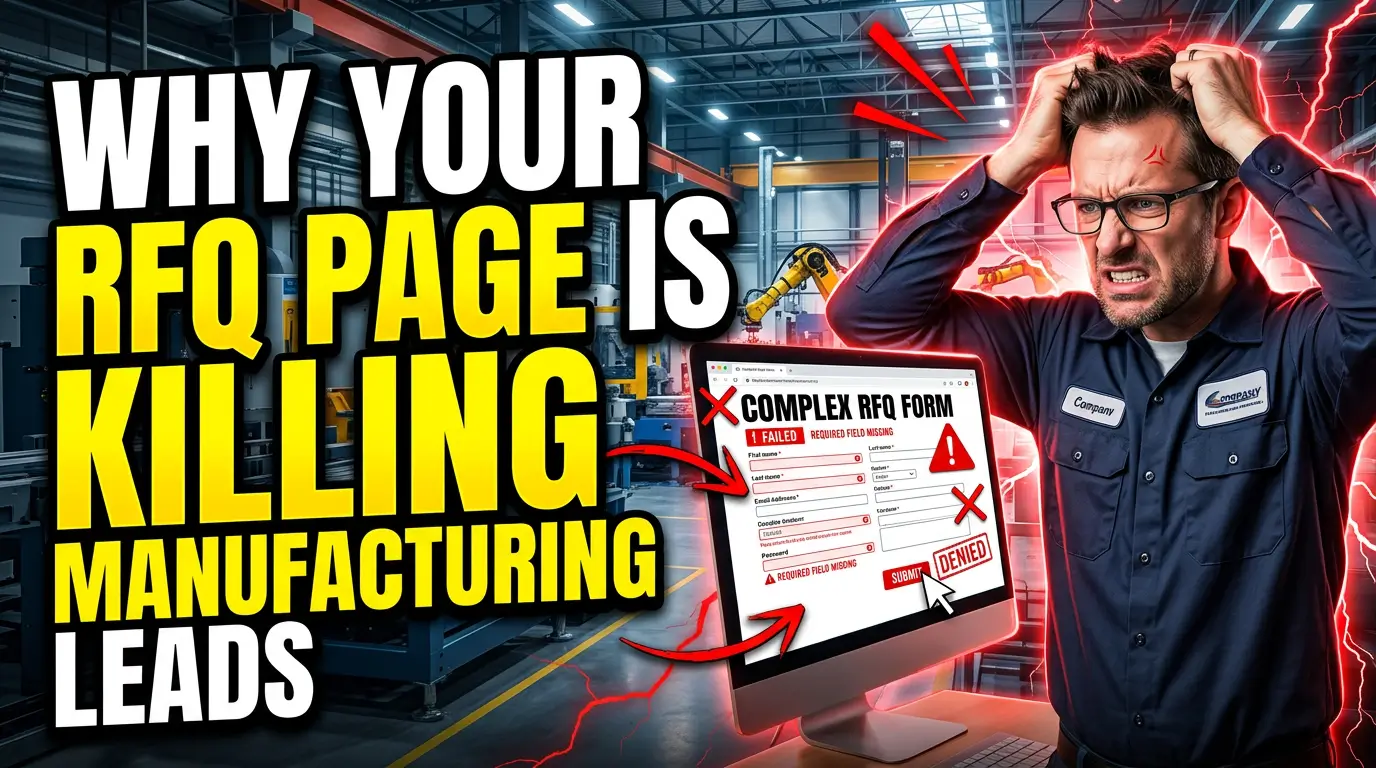
Manufacturing websites are notorious for forms that ask for everything except the user’s mother’s maiden name. Company revenue. Employee count. Annual procurement budget. “Upload your RFQ.”
The problem: The average B2B conversion rate hovers between 2-3% across all industries. When your form has 8+ fields, you’re actively selecting against busy engineers who’d rather email you directly than fill out a questionnaire.
The fix: Start minimal. Name, email, phone, and one open field: “Tell us about your project.” That’s it. You can qualify leads later. Research shows reducing form fields from 11 to 4 can increase conversions by 120%.
If you must have detailed specs for quoting, create a two-step process: simple contact form first, detailed specs after the initial response.
3. Zero Trust Signals Above the Fold
Manufacturing buyers are risk-averse by nature. They’re specifying parts that will go into products their customers rely on. A failed component means a failed product—and a failed career.
The problem: Your homepage has a stock photo of a CNC machine and your company history going back to 1987. There’s nothing that tells a new visitor they can trust you with a $50,000 order.
The fix: Build trust before you ask for anything. Add certifications (ISO 9001, AS9100, IATF 16949) prominently near your contact form. Include client logos—not the Fortune 500 giants everyone claims to work with, but recognizable companies in your target industries. Add a “Certifications” badge row in your header.
72% of B2B buyers say they need to see trust signals before engaging with a vendor. Don’t make them hunt for proof you’re legitimate.
4. Your “Capabilities” Page Is a Wall of Text
Open most manufacturing capability pages and you’ll find a PDF from 2003 converted to HTML. Walls of specifications. Endless process descriptions. No photos of actual work.
The problem: Modern buyers scan, they don’t read. Users read only 20-28% of page content. If your capability statement requires scrolling past three paragraphs of CNC terminology, you’re losing the 8-second attention battle.
The fix: Break capabilities into scannable sections with clear headings. Use process flow diagrams. Show photos of actual parts you’ve made—not stock imagery of generic machines. Include “Industries We Serve” with logos or vertical badges.
Consider a simple interactive selector: “I need [prototypes / production / both] - made from [aluminum / steel / plastic] - with [tight / standard] tolerances.”
5. No Clear Path for Different Buyer Stages
Your website tries to be everything to everyone, but it serves no one well. A procurement manager researching vendors has different needs than an engineer validating specifications, who has different needs than a decision-maker comparing quotes.
The problem: One-size-fits-all pages mean every visitor gets a generic experience. The engineer looking for tolerance data bounces because they can’t find specs. The decision-maker looking for capacity information bounces because you’re talking about precision.
The fix: Create clear pathways. Add a “I’m here to…” selector or prominent navigation for different roles: “For Engineers” → specs, certifications, CAD capabilities. “For Procurement” → capacity, lead times, pricing models. “For Leadership” → case studies, company overview, ROI calculators.
Companies that personalize web experiences see conversion rate increases of 20% or more. Meet visitors where they are.
6. Mobile Experience Is an Afterthought
Your website looks like it was built when “responsive” meant “it loads on a phone.” Buttons are too small to tap. Phone numbers aren’t clickable. Navigation requires pinch-zoom to read.
The problem: Over 60% of B2B searches now happen on mobile, and procurement managers increasingly research suppliers on phones during meetings. If your site frustrates mobile users, you’re literally invisible to the modern buyer journey.
The fix: Test your site on your own phone right now. Can you tap “Call” without dialing? Can you fill out your contact form with one hand? Can you read your main value proposition without zooming?
If any answer is no, that’s your priority. Google uses mobile-first indexing, meaning mobile experience directly impacts your search rankings.
7. No Live Chat or Rapid Response Option
Your website is a brochure. When a visitor has a question—right now, at 2 AM on a Tuesday—they have no way to get answers except filling a contact form and waiting for Monday.
The problem: 55% of companies using live chat see increased lead generation, and buyers increasingly expect immediate responses. Manufacturing buyers are comparing 5 vendors simultaneously. The one who responds fastest wins.
The fix: Add a live chat widget—even if it’s just basic qualification questions that route to your sales team’s Slack. Set expectations: “Typically responds in 2 hours” is better than nothing.
For 24/7 coverage, consider AI-powered chatbots trained on your FAQs. They can’t replace human conversations, but they can capture contact info and basic project details while your team sleeps.
8. Your Blog Is a Graveyard (or Doesn’t Exist)
You have a “News” section with a 2019 press release about your company picnic. Or worse—no blog at all.
The problem: B2B companies that blog generate 67% more leads than those that don’t. Manufacturing buyers are searching for solutions. They’re asking Google questions. “How to reduce CNC setup time.” “Qualifying suppliers for aerospace components.” If you’re not answering those questions, your competitors are.
The fix: Start with 4 content pillars relevant to your audience:
- Educational content for engineers (tolerances, material selection, process comparisons)
- Procurement guidance (cost reduction strategies, supplier qualification, lead time optimization)
- Industry news with analysis (supply chain trends, tariff impacts, technology adoption)
- Case studies showing real problem/solution scenarios
Publish one article per week. Promote it on LinkedIn. Build topical authority over time.
9. No Conversion-Optimized Landing Pages for Ads
You run LinkedIn ads pointing to your homepage. Your landing pages for trade show follow-ups go to generic “Thank you” pages. Your “Request a Quote” button links to a contact form buried 4 clicks deep.
The problem: Only 28% of B2B landing pages have a clear call-to-action above the fold, meaning the majority of pages fail to guide visitors toward conversion. When you pay for traffic and send it to generic pages, you’re burning money.
The fix: Every traffic source needs a dedicated landing page. LinkedIn ad about aerospace capabilities? Dedicated page highlighting aerospace certifications, relevant case studies, and an aerospace-specific quote request form. Trade show follow-up? Personalized landing page referencing the show, showing the specific machinery you demonstrated.
Match the message to the medium. Remove navigation. Remove distractions. One goal per page: the specific action you want that visitor to take.
The Bottom Line
Your website isn’t just a digital brochure. It’s your 24/7 salesperson, working when your team sleeps, answering questions when prospects are comparing vendors at midnight.
The manufacturers winning today aren’t spending more on marketing—they’re converting more of the traffic they already have. Fix these 9 mistakes, and you’ll stop leaving leads on the table.
Ready to turn your website into a lead-generating machine? Schedule a consultation and we’ll audit your site for the issues costing you the most pipeline.