B2B Manufacturing Lead Generation in 2026: What Actually Drives Results
Discover the proven strategies and statistics that drive manufacturing lead generation in 2026—from AI-powered targeting to multi-channel outreach that converts.
Richard Kastl

Yesterday I wrote about how AI answer engines are replacing Google for manufacturing buyers. The data from Forrester is stark: buyers using AI instead of search are one-tenth as likely to click through to your website, and B2B companies are seeing traffic declines between 10% and 40% over the past year.
That post generated some questions. The biggest one: “OK, I get it. AI is eating my web traffic. But what do I actually do about it?”
The answer is sitting in your customer base. And most manufacturers are completely ignoring it.
Here’s something that most manufacturers don’t realize about how AI answer engines work. ChatGPT, Gemini, Copilot, Perplexity — they don’t just scan your website and regurgitate your marketing copy. They cross-reference multiple sources. They look for consistency. They prioritize content that reads like it was written by a human with real experience, not a marketing department.
Forrester’s latest research on answer engine optimization makes the case plainly: AI systems favor original, expert-driven, human-authored material. And the single best source of that material? Your customers.
Think about it from the AI’s perspective. When a procurement engineer at an automotive OEM asks Copilot to “identify contract manufacturers with proven experience in high-tolerance aluminum die casting for EV battery housings,” the AI is looking for evidence. Not your claims. Evidence. Published case studies. Third-party reviews. Customer testimonials that name specific outcomes. Forum posts where someone says “we used Company X and they held ±0.002” tolerance across a 50,000-piece run.”
Your marketing copy says you’re great. Your customers prove it.
This is the part that should make you uncomfortable. According to Forrester, the vast majority of purchase influencers enter the B2B buying process with at least one vendor already in mind. They’ve already built a mental shortlist before they ever reach out to your sales team.
How did they build that list? Previous experience with a seller. Word of mouth from colleagues. Insight from experts they trust. And increasingly, AI-powered answer engines.
If you’re not showing up in those AI-generated answers, you’re not on the shortlist. And if you’re not on the shortlist, your sales team is fighting uphill from the first conversation.
For manufacturers, this is a particular problem. Most industrial companies have spent decades building their reputation through relationships, referrals, and trade shows. That reputation exists in the real world, but it doesn’t exist in the data that AI models consume. Your 30-year track record of delivering precision machined parts on time and on spec is invisible to Copilot unless someone wrote about it online, in a format that AI can find and verify.
AEO isn’t just SEO with a new name. Traditional SEO focused on getting Google to rank your pages. AEO focuses on getting AI models to cite you as a credible answer. The mechanics are different.
AI models don’t just look at your domain authority or backlink profile. They synthesize information from across the web. They weight content that appears in multiple contexts: a case study on your website, a review on a third-party platform, a mention in an industry publication, a customer post on LinkedIn. Consistency across sources matters more than any single piece of content.
This is where your customers become the differentiator. A single case study on your website is easy to write and easy for AI to dismiss as self-promotional. But when that same customer has also left a review on Thomasnet, mentioned you in a LinkedIn post, and spoken about the project at a regional NTMA chapter meeting, the AI has multiple independent data points confirming the same story. That’s what gets you cited.
Forrester specifically recommends that B2B companies activate their customers to share success stories across multiple channels, in their own words, using language their peers recognize. This isn’t about scripting testimonials. It’s about creating conditions where customers naturally talk about their experience with you.
I’m not going to give you a 20-point checklist. Here are five things you can actually do in the next 90 days that will change your visibility in AI-driven buyer research.
Audit your existing customer stories for AI readability. Pull up every case study, testimonial, and success story on your website. Read them through the lens of an AI trying to answer a specific buyer question. Do they include measurable outcomes? Specific materials, tolerances, volumes? Named industries? If your case study says “we helped a major automotive manufacturer improve quality,” rewrite it to say “we reduced defect rates by 34% for an automotive Tier 1 supplier producing aluminum die-cast EV battery housings at volumes of 15,000 units per month.” The specificity is what AI latches onto.
Ask your best customers to leave reviews on industry platforms. Thomasnet, Google Business Profile, Clutch (for engineering services), even LinkedIn recommendations. Each review creates another independent data point. Don’t script the review. Just ask them to describe the project, the challenge, and the result. Forrester’s research shows that AI models prioritize authentic third-party evidence, and reviews are one of the strongest signals.
Publish joint content with customers. Co-authored blog posts, joint webinar appearances, collaborative LinkedIn articles. When your customer’s name and your company’s name appear together in content published on their domain (not just yours), the AI sees a validated relationship. This is exponentially more powerful than any self-published case study.
Make your technical data structured and findable. AI models are increasingly good at parsing structured data. If your capabilities page is a PDF brochure from 2019, the AI can’t read it. Put your certifications, equipment lists, material capabilities, and tolerance ranges in structured HTML on your website. Use schema markup where appropriate. When a buyer asks Copilot “who can do 5-axis CNC machining in stainless steel 316L with AS9100 certification,” you want the AI to find that data without guessing.
Create a customer advocacy program, even a simple one. This doesn’t need to be complicated. Identify your top 10 customers by satisfaction and relationship strength. Reach out to each one with a specific ask: “Would you be willing to share a brief description of a project we worked on together?” Give them a simple template. Offer to write a draft they can edit. Forrester notes that 76% of B2B decision-makers who contribute to content have already created new guidelines for using AI tools in content creation. Your customers are already thinking about this stuff. Most of them will say yes if you make it easy.
For 50 years, a manufacturer’s reputation lived in handshakes, plant tours, and word of mouth at industry events. That reputation was real, but it was analog. It traveled through personal networks at the speed of conversation.
AI has changed the medium. Reputation now travels at the speed of inference. When a procurement team uses Copilot to evaluate suppliers, the AI is constructing a reputation model in real time, pulling from every digital trace your company has left. Every case study, every review, every mention in an industry forum, every structured data point on your website.
Manufacturers who have strong digital footprints backed by real customer stories will show up in those AI-generated answers. Manufacturers who don’t will be invisible, no matter how good their actual work is.
That’s the uncomfortable truth. Quality isn’t enough anymore. Capability isn’t enough. You have to make your track record findable by machines that are increasingly making the first cut on behalf of human buyers.
I talked to a specialty fastener manufacturer last month who had seen their inbound RFQs drop 25% over six months. Their quality hadn’t changed. Their pricing was competitive. Their delivery times had actually improved. But when I asked Copilot to “recommend specialty fastener manufacturers for aerospace applications with AS9100D certification,” they didn’t come up. Three of their competitors did.
The difference wasn’t capability. It was visibility. Those three competitors had published case studies with named customer outcomes, had reviews on multiple platforms, and had structured technical data on their websites that AI could parse. The specialty fastener manufacturer had a PDF catalog and a capabilities page that hadn’t been updated since 2022.
Their reputation in the aerospace community was excellent. Their reputation in the AI’s training data was nonexistent.
The instinct when you hear “you need to optimize for AI” is to call your marketing agency and ask for an AEO strategy. That’s not wrong, but it misses the most important step.
Start with your customers. Call your top five accounts this week. Ask them one question: “Would you be willing to share your experience working with us, in your own words, somewhere online?”
Most of them will say yes. Many of them will be flattered you asked. Some of them have already been talking about you in places you haven’t checked.
Forrester’s research shows that C-level executives are more comfortable speaking at events or in video than writing blog posts, while younger professionals tend to gravitate toward LinkedIn and online communities. Let your customers choose the format. The channel matters less than the authenticity.
Every customer story that gets published online is another data point for the AI. Another signal that your company is real, capable, and trusted by people who’ve actually worked with you. That’s the foundation of winning in an AI-driven market.
Your marketing team can amplify the signal. But your customers are the signal.
Is your company showing up when AI tools evaluate suppliers in your industry? If you’re not sure, that’s a problem worth solving. Schedule a consultation to find out where you stand and what it takes to get visible in the channels your buyers are already using.

Richard Kastl has been working with manufacturing companies to help them generate high-quality B2B leads. He is an entrepreneur with expertise as a web developer, digital marketer, copywriter, conversion optimizer, AI enthusiast, and overall talent stacker. He combines his technical skills with manufacturing industry knowledge to provide valuable insights and help companies connect with C-suite executives ready to buy.
Discover the proven strategies and statistics that drive manufacturing lead generation in 2026—from AI-powered targeting to multi-channel outreach that converts.
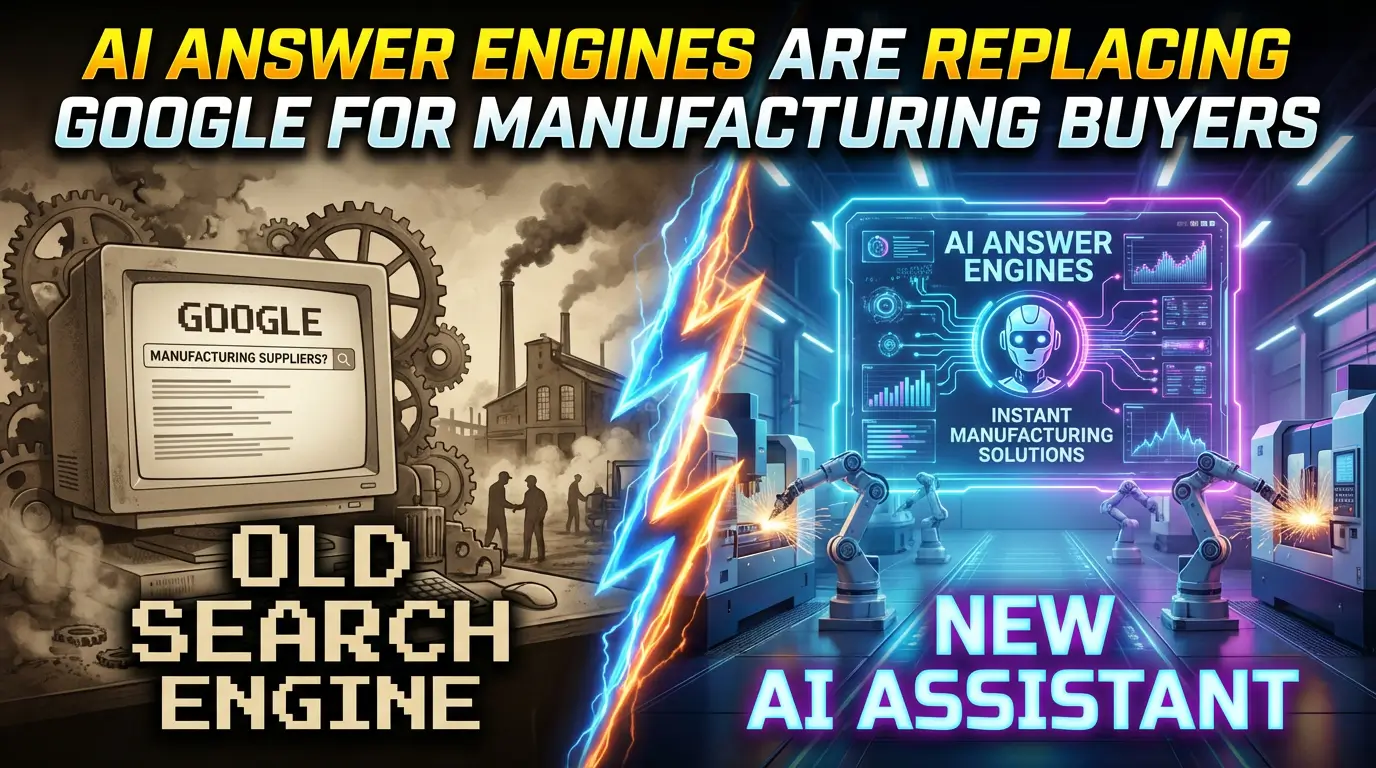
Forrester data shows B2B buyers using AI instead of search are one-tenth as likely to click through to your website. Here's what manufacturing companies need to do before their pipeline disappears.
Discover 11 proven ABM tactics manufacturing companies use to target high-value accounts, align sales and marketing, and close larger deals faster.