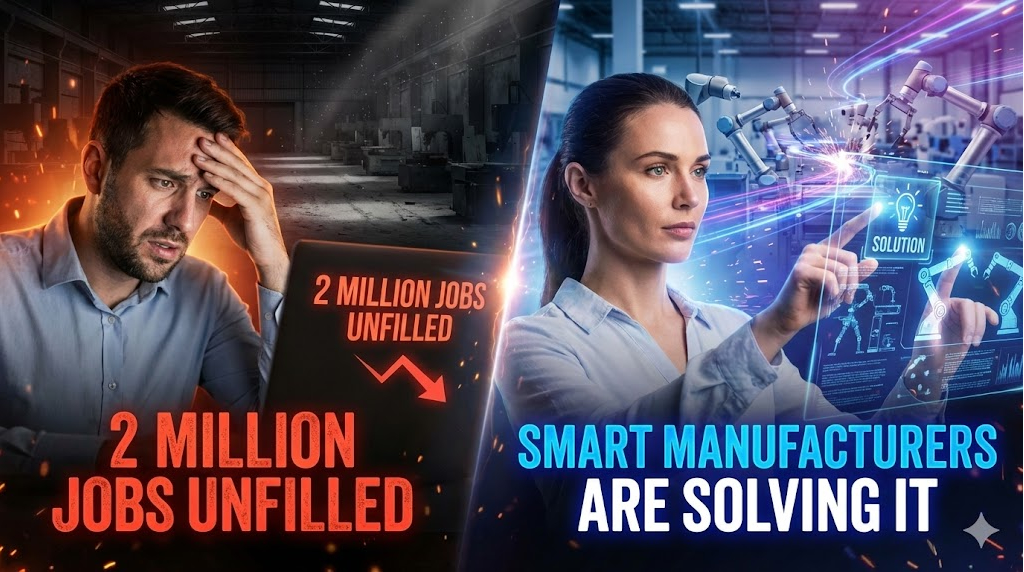
By 2033, American manufacturing will face a talent deficit of 1.9 to 2.1 million workers. That’s not a prediction. That’s a certainty baked into retirement demographics, generational participation rates, and industry growth projections. According to the National Association of Manufacturers’ 2025 workforce analysis, this structural labor crisis will either define your company’s future or constrain it indefinitely. We have eight years to act.
Here’s the good news: the manufacturers winning this crisis aren’t waiting for policy solutions or demographic miracles. They’re solving it now through strategic partnerships that multiply their recruitment effectiveness, transform their employer brand, and tap talent pools competitors haven’t yet mobilized.
The Real Cost of Ignoring This Crisis
Most manufacturing executives treat the workforce shortage as a recruiting problem. That’s the first mistake. It’s not a problem of finding people who want to work. It’s a problem of perception, credibility, and systematic access to talent pipelines that exist but remain invisible to individual manufacturers operating in isolation.
Consider what happens in the next 8 years if your company doesn’t act strategically. Three scenarios are playing out across manufacturing right now:
Scenario 1: The Talent Drought
You have work. No one to do it. Production capacity sits idle. Customer orders go unfulfilled. Market share migrates to competitors with better talent strategies. Your 2030 revenue targets slip to 2035 aspirations.
The median age of your workforce climbs above 50 as experienced workers retire and younger workers never arrive to replace them. Specialized roles go perpetually vacant, forcing you to turn down profitable work or operate at dangerously low staffing levels that spike safety incidents and quality problems.
Scenario 2: The Wage Spiral
You compete desperately for scarce talent by raising wages 20-30% to attract workers, compressing margins faster than you can adjust pricing. You hire less-qualified candidates and invest heavily in training that still doesn’t close skill gaps. Turnover accelerates as competitors poach your trained talent.
You’re playing defense instead of offense, reacting to market forces instead of shaping them. Your cost structure becomes uncompetitive against manufacturers in regions with better talent access.
Scenario 3: Strategic Competitive Advantage
You partner with workforce development experts, educational institutions, and talent acquisition specialists who understand manufacturing’s unique requirements. You build genuine employer brand advantage by becoming known as the manufacturer that actually invests in people.
You attract talent from non-traditional pipelines—veterans, women, career-changers, previously incarcerated individuals—that competitors haven’t yet mobilized. You become the employer of choice in your region. Your workforce stays stable and skilled. Your production runs at planned capacity. You capture market share from competitors still trapped in Scenarios 1 and 2.
The manufacturers choosing Scenario 3 aren’t waiting. Every month you delay, your competitive window narrows.
Why Individual Manufacturers Lose the Talent War
Manufacturing companies competing for talent in isolation operate under a structural disadvantage. A single manufacturer’s job posting gets lost in noise. Your employer brand—however strong locally—doesn’t reach the talent pipelines that actually exist: community colleges, veterans’ organizations, workforce development boards, career transition programs, and educational institutions.
You’re competing against larger companies with dedicated HR departments and national recruitment budgets. You’re competing against other manufacturers in your region offering similar wages and benefits. You’re not competing—you’re losing by default because you’re invisible to the talent sources that could solve your problem.
According to CSIS research on manufacturing competitiveness and supply chain resilience, manufacturers that invest in workforce partnerships and community engagement report 40% faster hiring cycles and 25% lower turnover than those relying solely on traditional recruitment. The data is unambiguous: strategic partnerships work.
But here’s what most manufacturers miss: you don’t need to build these partnerships alone. The solution isn’t hiring a recruiter. It’s accessing the infrastructure that already exists but operates at a community level.
How Smart Manufacturers Are Solving It Now
The manufacturers capturing Scenario 3 advantages are deploying three interconnected strategies:
Strategy 1: Educational Partnerships That Build Your Talent Pipeline Before You Need It
Smart manufacturers partner with community colleges, trade schools, and secondary vocational programs to shape curriculum around their actual skill requirements. They don’t wait for graduates to enter the market. They influence what those graduates learn.
A manufacturer in Ohio partners with local community colleges to embed their equipment and processes into the curriculum. Students graduate with hands-on experience on your equipment, understanding your processes, and pre-qualified for employment. The college benefits from industry relevance. The students benefit from job security and skill marketability. You benefit from a continuous pipeline of pre-trained talent.
This isn’t charity. It’s infrastructure investment that pays dividends for a decade. And it’s a competitive advantage your rivals won’t catch up on for three years—the time it takes to build similar relationships.
Strategy 2: Non-Traditional Talent Pipeline Development
The AI Revolution in Manufacturing is transforming production methods and skill requirements, making it easier to train talent from non-traditional backgrounds into high-value roles. Veterans, career-changers, and individuals returning to the workforce bring maturity, discipline, and motivation that traditional talent sources often lack.
Manufacturers working with veteran organizations, workforce re-entry programs, and community employment agencies access talent pools that larger companies haven’t mobilized. You’re not competing against tech companies for these candidates. You’re one of the few manufacturers offering clear career pathways.
A manufacturer in Texas partners with a veterans’ organization to recruit and place former military personnel into manufacturing leadership roles. The veterans bring leadership experience, problem-solving discipline, and reliability that costs nothing to instill. Turnover is 8% versus industry average of 22%. Advancement rates are twice the manufacturing standard.
Strategy 3: Regional Employer Brand Coalition Building
Individual manufacturer brand doesn’t scale. Regional manufacturing brand does. When 15-20 manufacturers in a region collectively market manufacturing careers, they shift the narrative from “manufacturing is dying and outdated” to “manufacturing is growing, technologically sophisticated, and offers real career paths.”
Manufacturers in a Pennsylvania region pooled recruitment resources to fund a coordinated marketing campaign: “Manufacturing Careers in [Region]” positioning manufacturing as high-skilled, high-wage work offering genuine advancement. Individual company names matter less than the collective signal: this region builds careers in manufacturing.
Participation costs each manufacturer $8,000-$15,000 annually. Recruitment velocity increased 35% across participants. Individual competitors still running solo recruitment strategies can’t match the reach or credibility.
The Regulatory and Policy Tailwind
According to DLA Piper’s recent analysis of industrials regulatory trends, policymakers at federal and state levels are increasing funding for workforce development, manufacturing apprenticeships, and skills training programs. The CHIPS Act allocated $5 billion for workforce development. State governments are launching manufacturing talent initiatives.
This is a 18-24 month window when government funding is available for partnership programs, training infrastructure, and regional talent initiatives. Manufacturers moving now access co-funded programs that won’t be available in 2027.
What Action Looks Like Right Now
If your manufacturing operation faces the workforce crisis—and statistically you do—here’s the concrete action sequence for the next 90 days:
Month 1: Assess and Partner
- Identify the 3-5 talent sources that would solve your hiring crisis: community colleges, vocational schools, veteran organizations, workforce boards
- Contact program directors directly
- Understand what partnership looks like: curriculum input, equipment access, job placement commitments, internship programs
Month 2: Pilot and Measure
- Launch a partnership with one institution or program
- Set specific metrics: hiring timeline, quality of candidates, retention rates
- Document the cost and outcome
Month 3: Scale and Integrate
- Expand successful partnerships
- Integrate outcomes into your broader recruitment and talent strategy
- Position yourself as an employer of choice in your region
The manufacturers who execute this sequence in 2025 will have workforce advantages their competitors won’t achieve until 2027 or 2028. That’s a two-year competitive gap in an industry where labor access is the primary constraint on growth.
The Window Is Closing
Eight years is a long time. It’s also the exact duration of the demographic crunch that will define manufacturing competitiveness. Every quarter you delay, the talent pool shrinks. Every quarter you delay, competitors who’ve already moved are consolidating advantages you can’t catch.
The workforce crisis isn’t coming. It’s here. The manufacturers solving it aren’t waiting for conditions to improve. They’re building the infrastructure now that will carry them through 2033 and beyond with stable, skilled, committed teams.
The question isn’t whether you’ll address this. It’s whether you’ll address it strategically while you still have advantage, or reactively when desperation narrows your choices and multiplies your costs.
Your move. Eight years remaining.