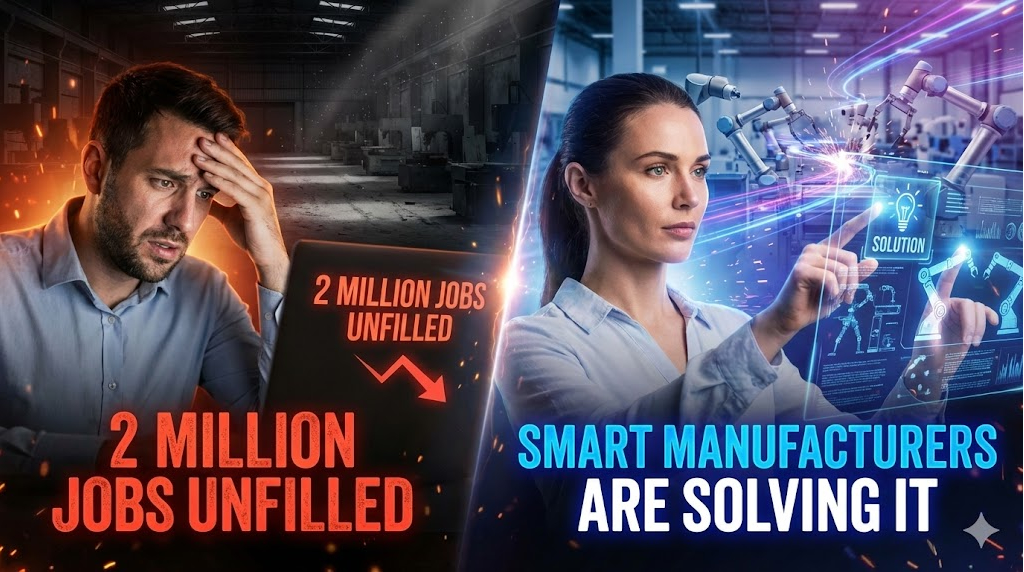
Here’s the brutal reality: Your company is about to spend millions on AI and automation systems. Your teams can’t effectively operate them. That’s not a technology problem—it’s a human one. And it’s happening right now across 72% of manufacturing plants in America.
But the manufacturers who solve this problem first don’t just avoid disaster. They capture disproportionate competitive advantage that rivals won’t catch for years.
The Data Everyone’s Talking About
Deloitte surveyed over 600 manufacturing executives in December 2024. The findings are stark: 80% of manufacturers plan to invest 20% or more of their improvement budgets specifically in smart manufacturing and AI. That translates to billions of dollars flooding into new equipment, software platforms, analytics tools, and automation hardware.
But here’s where it falls apart.
72% of these same manufacturers identify the skills gap as their primary barrier to success. They have the budget. They have the vision. They don’t have people who know how to run these systems at scale.
The Manufacturing Institute projects 2.1 million manufacturing jobs could go unfilled by 2030. The economic cost? Approximately $1 trillion in lost productivity. This workforce shortage is compounded by the rapid pace of technological change—manufacturers need workers who understand not just traditional production, but data analytics, machine learning systems, and digital platforms.
But that’s just the macro picture. The real damage happens inside your plants when million-dollar equipment operates at 40% capacity because your team can’t extract the insights it’s designed to provide.
What Happens When You Ignore This
Let’s be honest about the cascade of failure.
Year One: You deploy new AI-powered predictive maintenance systems. The software works perfectly. Your maintenance team has no idea how to interpret the alerts. Equipment you thought would run 98% uptime actually runs 82% because nobody knows how to act on the predictions. You’re spending $2M annually on a system that’s functionally broken.
Year Two: Implementation timelines slip. The vendor escalates issues. Your team blames the technology. The technology blames your team. Meanwhile, your competitor two states over deployed identical equipment and trained their people through integrated learning models. They’re now running 96% uptime. You’re hemorrhaging money.
Year Three: Your company abandons the initiative. You take a $10M write-down. Executives lose confidence in “digital transformation.” Your competitor is now 18-24 months ahead on efficiency, quality, and innovation. They’re capturing market share you’ll spend the next five years trying to reclaim.
This isn’t hypothetical. Manufacturing executives report this exact scenario happening across their portfolios.
Why the Skills Gap Exists (And Why It’s Getting Worse)
The root cause isn’t stupidity or negligence. It’s structural.
Traditional manufacturing talent pipelines are broken. For decades, manufacturing careers meant learning a specific machine or process. You apprenticed under someone who learned from someone else. Knowledge transferred vertically through hierarchies, not horizontally across platforms.
AI systems require different thinking. A predictive maintenance algorithm doesn’t care that your maintenance technician has 25 years of experience. It wants someone who understands:
- How to read statistical models and confidence intervals
- What sensor data actually means
- How to translate algorithmic recommendations into operational decisions
- When to trust the machine and when to override it
Your 25-year veteran might be your worst employee for AI-powered systems because they trust intuition over data.
Simultaneously, younger workers entering manufacturing have different expectations. They expect continuous learning, flexible career paths, and technology integration. The average manufacturing plant still operates like it’s 1995. The skilled workers see the gap and go elsewhere.
The Skills Gap Costs More Than You Think
Direct costs are obvious: underutilized equipment, extended ROI timelines, failed implementations.
But the indirect costs are where real damage accumulates:
- Talent drain: Your best people leave because they see broken systems and lack growth opportunities. The people with potential to learn new technologies are the first to abandon ship.
- Competitive disadvantage: While you’re still figuring out your AI investment, competitors are generating measurable returns. Market share shifts. Pricing pressure increases.
- Innovation paralysis: Manufacturers stuck managing failed AI deployments stop investing in the next generation of technology. You miss the window to capitalize on emerging opportunities.
- Recruitment difficulty: Word spreads. Ambitious manufacturing professionals don’t want to work somewhere stuck in legacy operations. Your hiring becomes increasingly difficult.
The $1 trillion productivity gap The Manufacturing Institute projects isn’t equally distributed. It concentrates on companies that fail to close their skills gap. Winners and losers diverge dramatically.
What Forward-Thinking Manufacturers Are Actually Doing
The manufacturers capturing competitive advantage aren’t waiting for the perfect worker to appear. They’re building capability systematically.
1. Embedding Learning Into Operations
Successful manufacturers treat skill development as an operational function, not a HR initiative. They allocate specific budget, assign accountability, and measure outcomes like they would production metrics.
This means:
- Dedicated training time (not “whenever you have a spare moment”)
- Structured curricula aligned to specific systems and roles
- Hands-on practice environments separate from production lines
- Clear advancement paths for employees who develop new capabilities
2. Hiring for Potential, Not Just Experience
Forward-thinking plants are recruiting people who demonstrate learning ability and curiosity, even if they lack direct manufacturing experience. They’re finding:
- Recent graduates with technical backgrounds (data science, engineering, computer science)
- Career-changers from other technical industries
- Military veterans with technical training and discipline
- People who’ve self-taught programming or data analysis basics
These hires often outperform experienced manufacturers because they approach problems without ingrained assumptions about “how things have always been done.”
3. Building Internal Expertise Centers
Leading manufacturers establish centers of excellence—small teams of deeply trained employees who become internal experts. These centers:
- Become the reference point for technology implementation
- Train other teams across the organization
- Continuously learn from vendors and stay ahead of capability evolution
- Validate whether new AI tools are actually valuable before broader deployment
This approach prevents the “deploy and abandon” cycle that kills most initiatives.
4. Partnering With Educational Institutions
Progressive manufacturers are working directly with community colleges, technical schools, and universities to shape curricula. They’re:
- Providing equipment access so students learn on real systems
- Guest lecturing to connect theory with practical problems
- Creating apprenticeship pathways that combine school and work
- Committing to hire graduates who complete programs
This creates a talent pipeline instead of competing for scarce resources.
5. Using External Training and Certification
Rather than building everything internally, smart manufacturers leverage:
- Vendor-provided certification programs (most AI/automation vendors offer training)
- Industry certifications in emerging technologies
- Online learning platforms tailored to manufacturing
- Consulting partnerships that include knowledge transfer
The key is systematic selection based on strategic priorities, not random training that doesn’t connect to business goals.
The Competitive Window Is Closing
Here’s what matters: The manufacturers solving this problem now will operate with structural advantages for years.
They’ll extract 95%+ efficiency from AI systems competitors take three years to implement. They’ll innovate faster because their teams understand both the technology and the operations deeply. They’ll attract talent because they offer genuine learning and advancement opportunities. They’ll capture market share while competitors are still fighting internal resistance to digital transformation.
This advantage compounds.
Every month you delay, competitors gain ground. Every year you ignore the skills gap, the distance between you and leaders widens.
The $1 trillion productivity opportunity The Manufacturing Institute projects? Most of that flows to manufacturers who close their skills gap first. Everyone else fights for scraps from an increasingly competitive market.
Start Here
If you’re a manufacturing leader reading this, the answer isn’t “wait for better workers to appear.” The answer is:
-
Assess your current skills reality. Be honest about what your teams actually know about your AI and automation systems. This usually requires external assessment because internal estimates are wildly optimistic.
-
Identify your strategic bottlenecks. Which systems or processes create the biggest gap between potential and current performance? Start there. Don’t try to solve everything simultaneously.
-
Build a 12-month capability plan. Who needs to learn what? Through what mechanism? With what accountability? What does success look like?
-
Allocate real resources. Training budget that comes from operational savings isn’t real budget—it gets cut first. Make it a line item.
-
Measure outcomes. If you’re not tracking whether specific training improves equipment utilization, product quality, or cycle time, you’re not serious about closing the gap.
The manufacturers who move in the next 90 days will be positioned differently than those who wait another year. The question is which category your company falls into.