Your website traffic dropped 20% last quarter and nobody in your marketing team can explain why. The content is still ranking. The ads are still running. The trade show leads came in on schedule. But fewer people are landing on your site, and the ones who do are behaving differently.
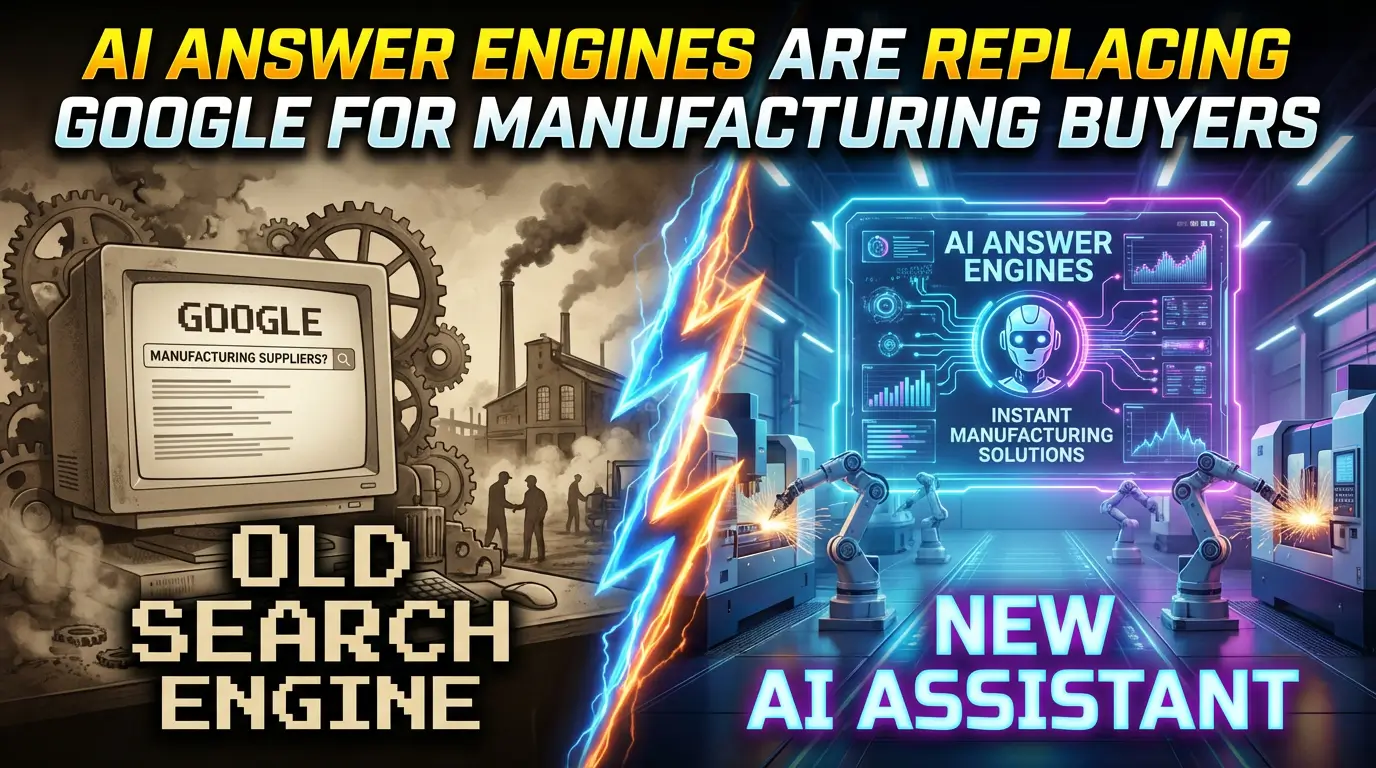
Here’s what happened: your buyers stopped Googling.
Not entirely, and not all at once. But Forrester’s latest research paints a picture that should worry every manufacturer with a digital marketing budget. When B2B buyers use AI tools instead of traditional search, they are one-tenth as likely to click through to your website. And B2B companies are already seeing traffic declines between 10% and 40% over the past year.
If you’re a CNC machining shop, a contract manufacturer, or an industrial OEM that spent the last five years building out your SEO strategy, that stat should feel like a gut punch.
Your Buyers Are Already Using AI to Find Suppliers
This isn’t a prediction about what might happen in 2027. It’s happening right now.
According to Forrester’s Buyers’ Journey Survey, 2025, business buyers are adopting AI faster than consumers. More than half of business buyers report using private AI tools provided by their company. Microsoft Copilot is the most widely used AI tool among B2B buyers, with 68% reporting they use it. And more than half of those users (36% of all buyers) are running Copilot behind their corporate firewall.
Think about what that means for a manufacturing procurement team. The engineer evaluating your capabilities isn’t typing “custom aluminum extrusion suppliers Midwest” into Google anymore. They’re asking Copilot, “Compare the top five aluminum extrusion suppliers in the Midwest with ISO 9001 certification and lead times under six weeks.” And Copilot is pulling that answer from somewhere, cross-referencing data, and delivering it without the buyer ever visiting your website.
The buyers who still do search on Google are increasingly getting their answers right on the search results page. Google’s AI Overviews, featured snippets, and knowledge panels mean fewer clicks even for traditional searches. The industry calls this “zero-click search,” and it’s been growing for years. AI answer engines just put it on steroids.
It’s Not Just Search That’s Changing
What caught my attention in the Forrester data is that AI isn’t simply replacing the search bar. Buyers are using it for tasks that go way beyond “find me a supplier.”
Forrester found that 54% of B2B buyers use AI to research product information. 55% use it to make product comparisons. But they’re also using AI to analyze RFP responses (48%) and build business cases (47%). These are tasks that used to involve spreadsheets, phone calls to colleagues, and visits to multiple vendor websites. Now they happen inside a single AI interface.
Forrester’s analysts also point to what’s coming next: procurement agents. AI systems that will automatically review vendor meeting transcripts, demo recordings, and internal team debriefs, then filter out personal preferences and surface objective pros and cons across competing suppliers. If your content, your case studies, and your technical documentation aren’t structured in a way these systems can consume, you’re invisible during the most critical part of the buying process.
For manufacturers, this has an uncomfortable implication. That beautiful website redesign you just finished? The one with the hero video and the interactive capabilities matrix? It matters less than whether an AI system can accurately parse and present your capabilities when a buyer asks about them.
What Answer Engine Optimization Actually Looks Like for Manufacturers
You’ve probably heard the term “AEO” (Answer Engine Optimization) floating around. Forrester has been pushing this concept hard, and their research on AEO strategy offers some specific guidance that translates well to manufacturing.
The core idea: AI answer engines favor original, expert-driven, human-authored content. They cross-reference information across multiple sources, looking for consistency and credibility. They prioritize content that helps buyers make decisions, not content that just describes your products.
Here’s what that means in practice for a manufacturer:
Get your customer stories out of the sales deck and onto the open web. Forrester’s research is clear that customer success stories are your biggest advantage in AI answer engine results. But most manufacturers bury their best case studies behind PDF downloads or keep them as internal sales tools. AI systems can’t index a PDF sitting behind a form. They can index a well-structured case study published on your blog with specific outcomes, named processes, and quantified results.
Structure your technical content for AI consumption. Your spec sheets, tolerance tables, material capabilities, and process descriptions should be in clean, crawlable HTML. Not embedded in PDFs. Not locked in image-based formats. The manufacturer that has a clearly structured page saying “We hold tolerances of +/- 0.001 inches on CNC turned parts in 304 stainless steel” will get cited by AI systems. The one with the same information buried in a 40-page PDF catalog won’t.
Be consistent across every channel. AI systems cross-reference your website, your LinkedIn presence, your Google Business Profile, industry directories like ThomasNet, and third-party review sites. If your website says you have 50 CNC machines but your ThomasNet profile says 35 and your LinkedIn says “state-of-the-art facility,” the inconsistency hurts your credibility in AI-generated answers.
I know. Most manufacturing executives would rather get a root canal than post on LinkedIn. But Forrester’s 2026 research on social media in B2B buying shows something that can’t be ignored.
Social media is now the second most meaningful source of information for B2B buyers, right behind AI search tools. It’s the highest-ranking digital interaction that vendors can directly publish to, surpassing even company websites.
And the generational shift is accelerating this. Millennials and Gen Z now make up 63% of B2B buyers surveyed by Forrester. Over half of Gen Z buyers find five or more social platforms meaningful in their purchase journey. These aren’t just the junior engineers anymore. Millennials are plant managers, VP of operations, directors of procurement. They’re the decision-makers, and they’re checking LinkedIn, YouTube, and even Reddit before they pick up the phone.
For manufacturers, the play here is straightforward. Your engineers and technical team know things that buyers find genuinely useful. A 90-second video of your quality inspection process. A LinkedIn post explaining why a specific alloy performs better in high-temperature applications. A shop floor photo showing your new five-axis machine with a caption about what it means for your customers’ lead times. This is the kind of content that builds trust with both human buyers and the AI systems those buyers are using.
The MCP Factor: What Manufacturers Should Watch
One of the more technical developments Forrester flagged is Model Context Protocol (MCP) as a potential mechanism for providing AI systems with trusted, structured data about your company. Think of it like an API for AI: instead of hoping an AI scrapes your website correctly, you can provide a structured data feed that AI tools can access directly.
This is still emerging technology, but manufacturers who have already invested in structured product data through systems like PIM (Product Information Management) are going to be ahead of the curve. If you’ve spent the last few years cleaning up your product data for your e-commerce platform or ERP system, that same data could become the foundation for making your company visible to AI procurement tools.
The companies that figured out EDI (Electronic Data Interchange) early got preferred vendor status with major OEMs. MCP and similar protocols could play the same role for AI-driven procurement. It’s too early to say this is a must-do, but it’s worth tracking.
What to Do This Quarter
You don’t need to overhaul your entire marketing strategy overnight. But you do need to start adapting. Here’s where to focus your next 90 days:
Audit your AI visibility. Open ChatGPT, Copilot, Perplexity, and Google Gemini. Search for the types of suppliers or capabilities your company offers. See what comes up. If your competitors are appearing and you’re not, that tells you everything you need to know about urgency.
Publish three customer case studies on your website in full text. Not PDFs. Not gated content. Full HTML pages with specific processes, materials, quantities, lead times, and outcomes. Make them detailed enough that an AI system would confidently cite you as a source.
Clean up your cross-channel presence. Make sure your capabilities, certifications, equipment lists, and company details match across your website, Google Business Profile, ThomasNet, LinkedIn, and any industry directories you’re listed in.
Start a LinkedIn presence for your company and at least one technical leader. It doesn’t have to be polished. A manufacturing buyer would rather see a real photo from your shop floor with honest commentary than a perfectly designed marketing graphic.
The manufacturers who adapt to this shift will capture the buyers who never even make it to a traditional search result. The ones who don’t will keep wondering why their traffic keeps dropping and their pipeline keeps shrinking, even though their Google rankings look fine.
Traditional SEO isn’t dead. But it’s no longer enough. The question isn’t whether AI is changing how your buyers find suppliers. The question is whether you’ll be the supplier they find.
Ready to build a lead generation strategy that works in the AI search era? Let’s talk about how to future-proof your manufacturing pipeline →