$330 Billion in Factory Investments Are Breaking Ground Right Now—Here's How to Capture Your Share
Richard Kastl •
$330 Billion in Factory Investments Are Breaking Ground Right Now
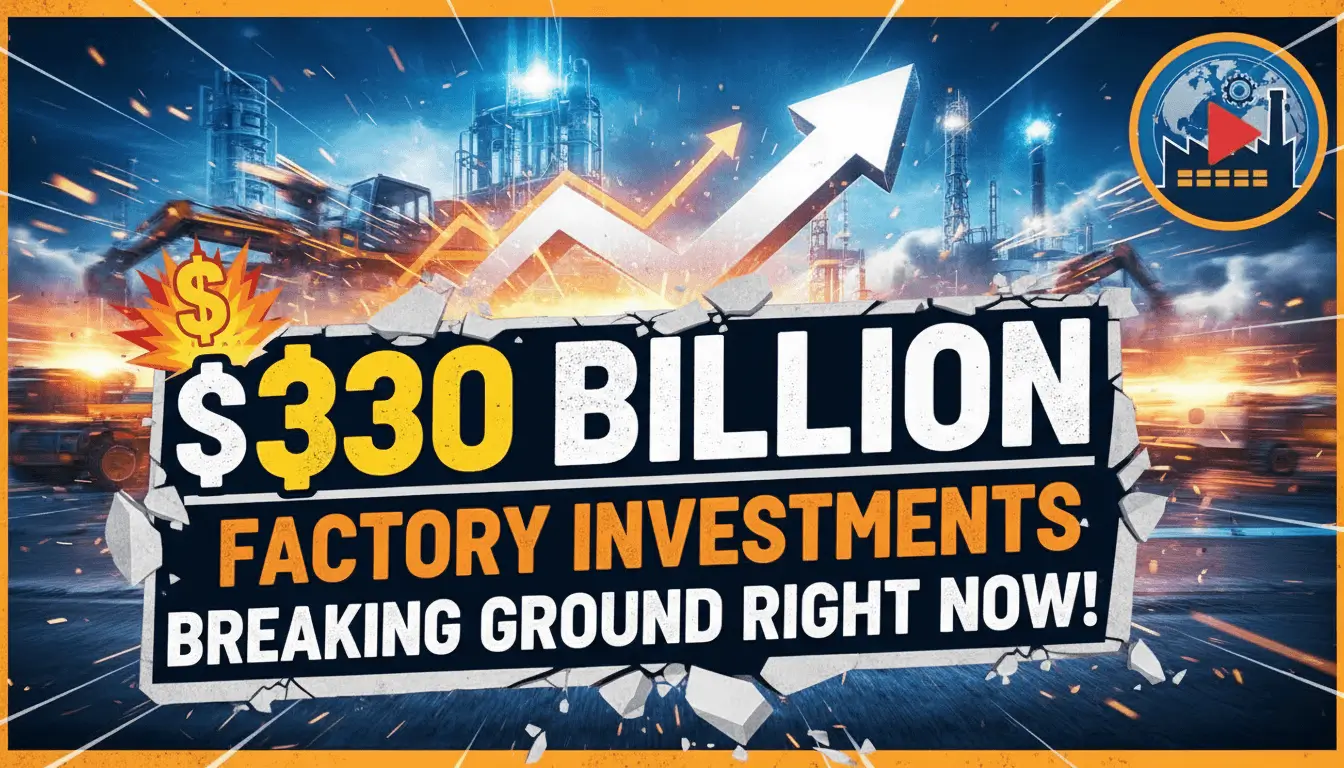
While everyone’s talking about manufacturing job losses, something massive is happening in the opposite direction: over $330 billion in factory construction projects are breaking ground across the United States this year. Micron alone is spending $200 billion. Lilly just committed $27 billion. Samsung, Stellantis, Texas Instruments, Rivian—they’re all building.
This isn’t speculation. Shovels are hitting dirt right now. And if you’re in B2B manufacturing sales, this is the biggest opportunity pipeline you’ll see in your career.
The Investment Tsunami You’re Missing
Here’s what’s actually happening on the ground:
Micron just broke ground on a memory chip facility in New York. They’re spending $200 billion across Idaho, New York, and Virginia—$150 billion on fabs, $50 billion on R&D. This single company is creating 90,000 direct and indirect jobs [1].
Samsung Electronics resumed construction on their $17 billion semiconductor plant in Taylor, Texas after a brief pause. It’s expected to be operational this year with 1,800 jobs in the first decade [1].
Stellantis committed $13 billion to expand production by 50% across Illinois, Indiana, Michigan, and Ohio. Indiana production starts this year. Over 5,000 jobs [1].
Eli Lilly is building a $6 billion pharmaceutical manufacturing facility in Huntsville, Alabama—breaking ground in 2026. This is part of a $50 billion expansion described as the largest pharmaceutical investment in U.S. history [1].
Texas Instruments is adding an $11 billion semiconductor fab in Utah. Production targeted for this year. 800 direct jobs, thousands more indirect [1].
Rivian finally started their $5 billion EV plant in Georgia. 400,000 vehicles annually by 2028. 7,500 jobs paying $56K+ average [1].
And that’s not counting Tesla’s $3.6 billion semi-truck plant in Nevada, Hyundai’s $5 billion steel plant in Louisiana, or JetZero’s $4.7 billion aircraft facility in North Carolina [1].
Why This Is Happening Now
Three forces are converging:
Federal policy is making imports expensive. Tariffs on foreign goods and restrictions on hiring foreign workers are pushing companies to build domestically. The math changed.
CHIPS Act money is flowing. Micron alone secured $6.4 billion in federal funding. Samsung got $4.7 billion. This free money accelerates timelines and de-risks massive projects.
State incentives are stacking. Georgia is giving Rivian $1.5 billion if they hit job targets. Texas rolled out the red carpet for Samsung. Every state wants these facilities, and they’re paying for them.
What This Means for Your Pipeline
Every major factory project creates a cascade of opportunities:
Tier 1: Direct suppliers. Equipment, materials, components. If you sell anything that goes into building or running a factory, these projects are your targets.
Tier 2: Service providers. Staffing, maintenance, logistics, IT. A 90,000-job project doesn’t hire internally—they contract everything.
Tier 3: Regional spillover. When Micron builds in Idaho, every business within 50 miles benefits. Hotels, restaurants, housing—but also local manufacturers who suddenly have a massive customer next door.
The Autonomous Operations Angle
Here’s what most salespeople miss: these aren’t just bigger factories. They’re smarter factories.
According to the National Association of Manufacturers, 2026 is the year manufacturing shifts “toward operations that can sense, respond and optimize with minimal human intervention” [2]. These new facilities are being built from the ground up with AI-powered autonomous systems.
That means:
Self-adjusting equipment that doesn’t need manual intervention
Networks of sensors creating connected factory ecosystems
Engineering teams focused on algorithms, not assembly lines
If you sell automation, sensors, analytics, or AI tools—these projects are building exactly what you offer. And they’re building it now.
How to Get In Front of This
Step 1: Map the timeline. Micron’s NY fab broke ground in January. Samsung expects operations this year. Stellantis Indiana production starts in 2026. Each project has procurement cycles you can intercept.
Step 2: Target the decision layers. These aren’t single-buyer decisions. Project managers, procurement, engineering, facilities, HR—each controls different budgets. Identify who buys what you sell.
Step 3: Go regional. Don’t just target the company—target the ecosystem. Idaho is about to have a massive semiconductor hub. Georgia is becoming an EV manufacturing center. The suppliers and contractors in those regions need everything.
Step 4: Lead with the problem they’re solving. These companies aren’t building factories for fun. They’re solving supply chain vulnerability, tariff exposure, and talent access. Frame your solution in those terms.
The Window Is Open—But Closing
Manufacturing construction spending actually declined from its 2024 peak [1]. The projects happening now are the survivors—the ones with committed funding and clear timelines. The companies that didn’t secure financing or incentives? They canceled.
That means the remaining projects are serious. Funded. Moving forward.
It also means the vendor selection is happening now. By the time these facilities are operational, the supplier relationships will be locked. The staffing contracts will be signed. The service agreements will be in place.
If you’re not in the conversation today, you won’t be in the building tomorrow.
Richard Kastl has been working with manufacturing companies to help them generate high-quality B2B leads. He is an entrepreneur with expertise as a web developer, digital marketer, copywriter, conversion optimizer, AI enthusiast, and overall talent stacker. He combines his technical skills with manufacturing industry knowledge to provide valuable insights and help companies connect with C-suite executives ready to buy.