
9 Manufacturing Website Mistakes That Are Killing Your Lead Flow
Manufacturers lose 98% of website visitors without capturing a trace. Here's why—and the fixes that actually work.
Richard Kastl

Here’s a stat that should keep every manufacturing executive up at night: 70% of the B2B buyer’s journey is completed online before a prospect ever picks up the phone. That means procurement teams, engineers, and plant managers are evaluating your company right now, scrolling through your website, comparing you against three or four competitors, and making decisions you don’t even know about.
And most manufacturing websites are failing this test.
The average B2B manufacturing website converts at roughly 2.2% of visitors into leads. That means for every 1,000 visitors, 978 leave without a trace. Some of that is normal. But a significant chunk of those lost visitors are qualified buyers who decided your site didn’t give them what they needed.
The frustrating part? The problems are usually fixable. They’re not about budget or technology. They’re about understanding how industrial buyers actually research and evaluate suppliers online. Here are the 11 most common reasons your manufacturing website is bleeding leads, and exactly what to do about each one.
This is the single biggest mistake, and Cazbah’s 2026 research on manufacturing website design nails it: most manufacturers assume their website’s primary job is to “look professional.” It isn’t. Its job is to help buyers validate you as a supplier, compare your capabilities, and take the next step.
A digital brochure says “we’re a precision machining company with 40 years of experience.” A sales tool shows tolerances you hold, materials you work with, industries you serve, and gives the engineer a reason to request a quote in the next five minutes.
Fix it: Audit every page and ask, “Does this help a buyer make a decision, or does it just describe us?” If it’s the latter, rewrite it.
Most manufacturing websites organize navigation around internal departments. “About Us,” “Services,” “Products,” “Contact.” That’s how your org chart looks, not how a procurement manager shops.
Buyers think in terms of problems, capabilities, and applications. They want to know: can you handle my material? Do you serve my industry? Can you meet my tolerance requirements? If the answer to those questions requires clicking through four pages and reading between the lines, you’ve already lost them to a competitor with clearer navigation.
Fix it: Add capability-based and industry-based navigation paths. Kongskilde Industries does this well by segmenting “Industrial” and “Grain” right on the homepage, so visitors self-select into the content that matters to them.
Engineers and technical buyers don’t want marketing copy. They want specifications, tolerances, material data sheets, process descriptions, and case studies with actual numbers. If your site reads like it was written by someone who’s never set foot on a shop floor, technical buyers will bounce.
Gartner’s B2B buying research shows that buying committees now include an average of 11+ decision-makers. The engineer doing the initial research has different needs than the VP approving the purchase. Your site needs to serve both.
Fix it: Create dedicated technical resource sections. FasTest lets engineers filter by part type, download CAD drawings, and access technical specifications without digging through marketing pages. That’s the standard now, not the exception.
80% of B2B buyers use mobile devices at work, according to Smart Insights. They’re checking your site between meetings, on the plant floor, or while traveling. And 40% of users will go to a competitor after a bad mobile experience.
Many manufacturing sites are loaded with uncompressed images, bloated scripts, and designs that weren’t built with mobile in mind. A procurement manager pulling up your site on a phone during a lunch break isn’t going to wait 8 seconds for your hero image to load.
Fix it: Run your site through Google PageSpeed Insights. Compress images, remove unnecessary scripts, and test every critical page on a phone. If your site scores below 50 on mobile, you’ve got work to do.
You’d be surprised how many manufacturing websites have capability pages, product pages, even case studies, with no obvious next step for the visitor. No “Request a Quote” button. No “Download the Spec Sheet.” No “Talk to an Engineer.” Just a wall of text and a hope that someone will find the Contact page.
Every page that describes a capability or product is a conversion opportunity. If you’re not explicitly asking for the next step, you’re leaving it up to the visitor. They won’t figure it out.
Fix it: Every product page and capability page needs a specific CTA. Not just “Contact Us.” Try “Request a Quote for [Specific Service]” or “Download the [Material] Spec Sheet.” The more specific, the better.
Procurement teams are risk-averse by nature. They’re not just evaluating what you can do. They’re evaluating whether you’re a safe bet. Every contract manufacturer and job shop claims “quality” and “precision.” Procurement wants proof.
The trust signals that actually matter in manufacturing: ISO certifications displayed prominently, ITAR registration if applicable, customer logos (with permission), case studies with measurable outcomes, and equipment lists that show your capacity. If these are buried in a PDF somewhere or missing entirely, you’re asking buyers to take your word for it. They won’t.
Fix it: Create a dedicated certifications/quality page and surface those credentials on every relevant capability page. Minnesota Rubber & Plastics does this effectively, pairing strong visuals with deep technical authority.
Think about what you’re asking a prospect to do. Many manufacturing RFQ forms require 15+ fields, file uploads that break on mobile, and no confirmation of what happens next. That’s friction, and friction kills conversions.
Compare that to a competitor who has a simple form with five fields and a follow-up call within two hours. Who do you think gets the business?
Fix it: Cut your RFQ form to the essentials: name, company, email, phone, and a description of what they need. You can qualify them on the call. If you need file uploads, make sure they work on every device and browser. And always tell the visitor what happens after they submit, like “We’ll review your requirements and get back to you within one business day.”
“We helped a customer improve their process” is useless. “We reduced a Tier 1 automotive supplier’s scrap rate from 4.2% to 0.8%, saving them $340,000 annually” is a reason to call you.
Most manufacturing websites either have no case studies at all, or they have vague, anonymous stories that don’t prove anything. Industrial buyers want specifics: what was the problem, what did you do, and what were the measurable results?
Fix it: Start with your best three customers. Ask for permission to share results. Include specific metrics: cycle time reductions, cost savings, quality improvements, lead time changes. Name the industry at minimum, the company if they’ll allow it.
Here’s something Nopio’s 2026 manufacturing digital marketing guide makes clear: manufacturers have increased digital marketing budgets from 6.7% of revenue in 2024 to 9.5% in 2025 (per Gartner). But throwing money at digital channels doesn’t work if your website content doesn’t match what buyers are searching for.
A procurement manager isn’t Googling “innovative manufacturing solutions.” They’re searching for “5-axis CNC machining titanium aerospace parts” or “ISO 13485 medical device contract manufacturer.” If your site doesn’t contain those specific, long-tail phrases, you’re invisible to the people who are ready to buy.
Fix it: Interview your sales team. Ask them what questions prospects ask on the first call. Those questions are your keyword targets. Build dedicated pages around each one.
This isn’t strictly a website problem, but it’s connected. Forrester’s research shows B2B buyers now engage in 62+ touchpoints before signing a deal. When someone fills out your contact form at 2 PM on a Tuesday, they’ve probably also submitted forms to two other suppliers. The first company to respond with a thoughtful, relevant reply has a massive advantage.
Too many manufacturers let form submissions sit in a shared inbox for 24 to 48 hours. By then, your competitor has already had a phone call and sent a preliminary quote.
Fix it: Set up automated email acknowledgments that go out immediately. Then establish a response SLA: every form submission gets a human reply within two hours during business hours. If you can’t do that with current staff, it’s time to rethink priorities.
Every three to five years, someone decides the website “needs a refresh.” A big redesign project kicks off. For six months, all energy goes into the new design. It launches, everyone celebrates, and then the site sits static for another three years while leads trickle in.
This cycle is broken. The best manufacturing websites are treated like living sales tools that get updated continuously. New case studies, fresh capability pages, updated certifications, blog content that targets new keywords. Small, consistent improvements compound over time.
Fix it: Skip the big redesign. Instead, commit to updating one page per week. Add a case study every month. Publish a blog post targeting a specific buyer keyword every week. After a year of this, you’ll have a site that outperforms any one-time redesign.
You don’t need to fix all 11 problems at once. Start with the ones that represent the biggest gaps between your site and how your buyers actually shop. For most manufacturers, the highest-impact fixes are:
Run your site through Google PageSpeed Insights and fix anything scoring below 50. Rewrite your top three capability pages with specific technical details and clear CTAs. Create one case study with real, measurable results. Simplify your RFQ form to five fields or fewer.
That’s a month’s worth of work that will produce more leads than any redesign committee meeting.
If you’re not sure where to start or want an outside perspective on what’s actually costing you leads, schedule a free consultation and we’ll walk through your site together. No pitch, just a straight assessment of what’s working, what isn’t, and what to fix first.

Richard Kastl has been working with manufacturing companies to help them generate high-quality B2B leads. He is an entrepreneur with expertise as a web developer, digital marketer, copywriter, conversion optimizer, AI enthusiast, and overall talent stacker. He combines his technical skills with manufacturing industry knowledge to provide valuable insights and help companies connect with C-suite executives ready to buy.
Manufacturers lose 98% of website visitors without capturing a trace. Here's why—and the fixes that actually work.
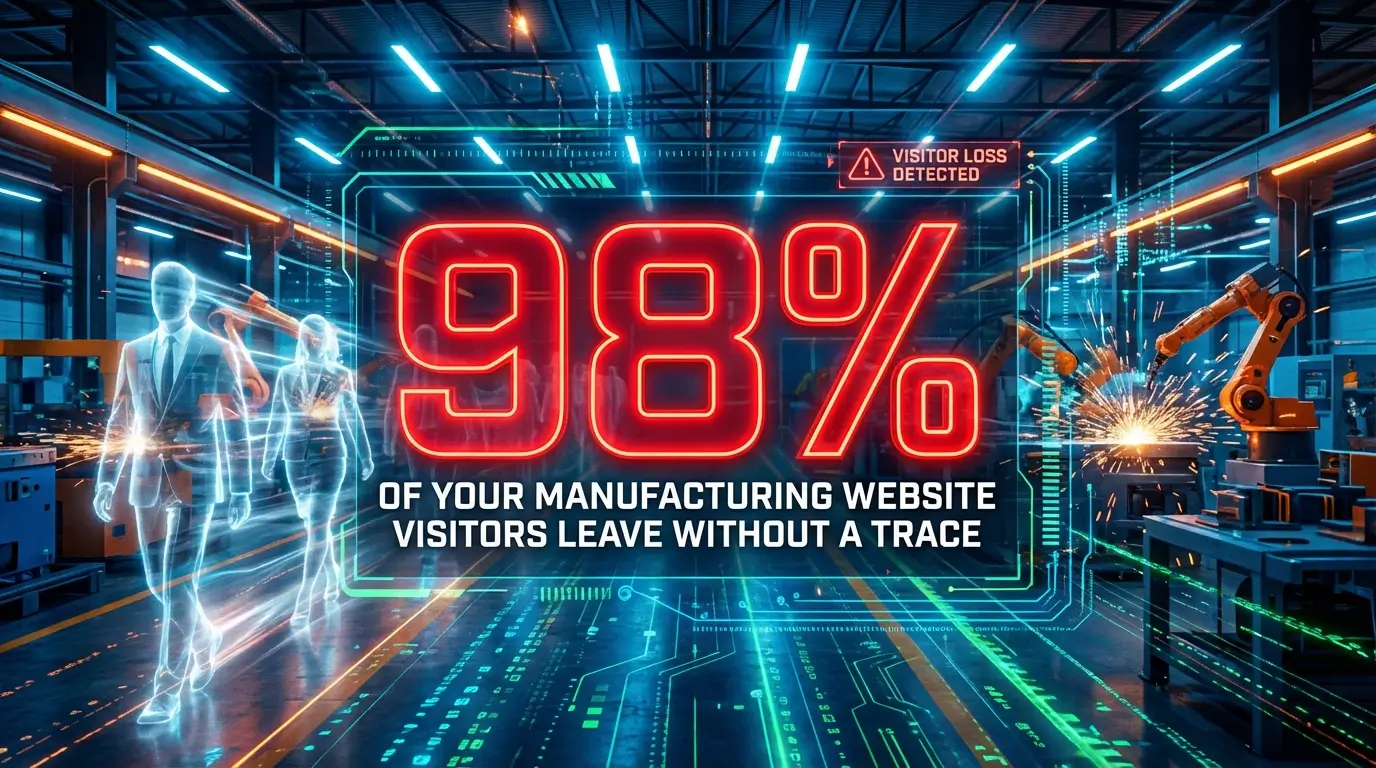
Only 2% of B2B manufacturing website traffic converts into leads. Discover the proven strategies top manufacturers use to identify, engage, and convert the invisible 98% into real pipeline.
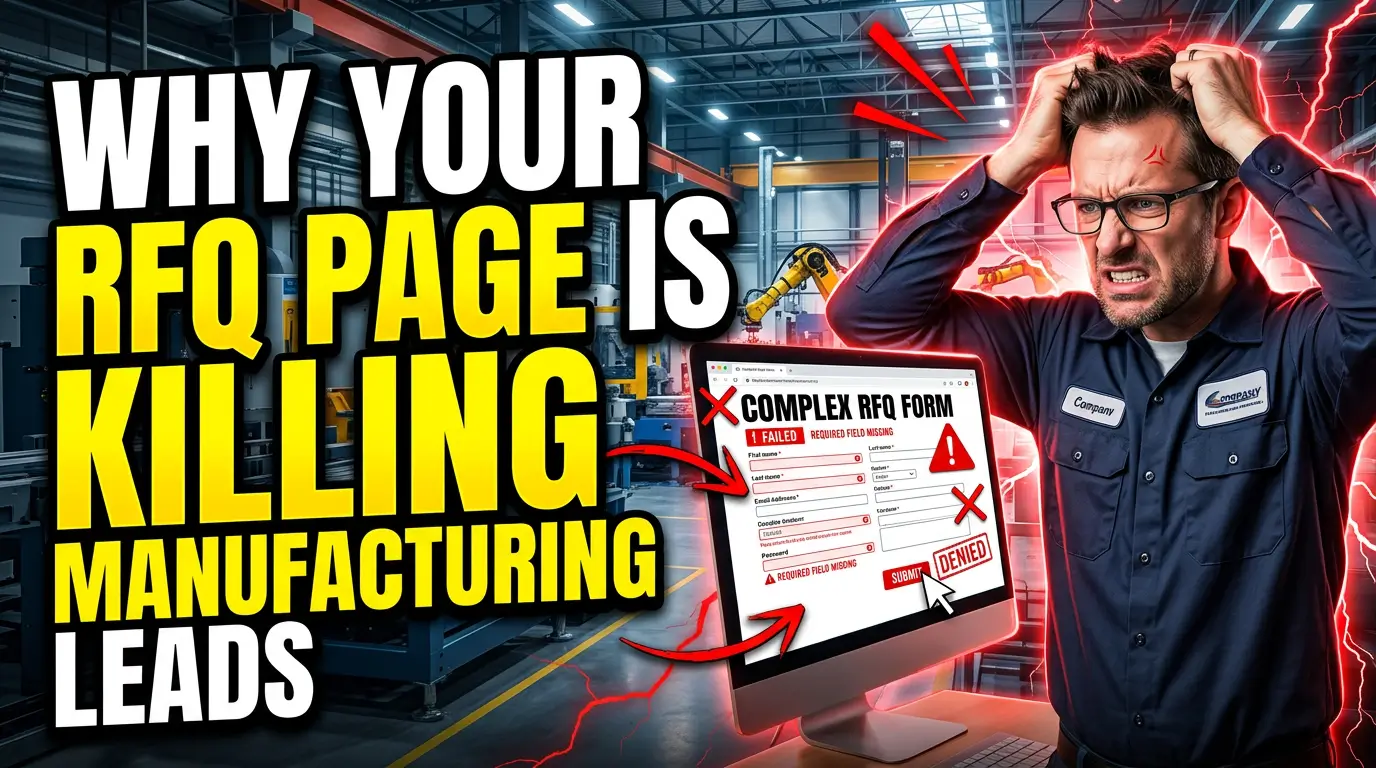
Most manufacturing websites drive qualified traffic to an RFQ page that's actively repelling buyers. Here's what's going wrong — and the exact fixes that increase quote requests by 30–40%.